
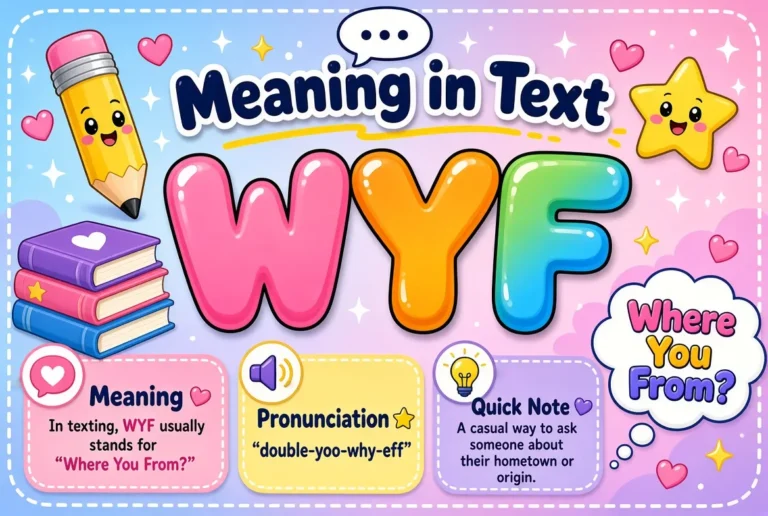
If you have received “WYF” in a message and are wondering what it means, the most likely answer is “Where You From?”
It is a casual texting abbreviation people use when they want to know someone’s location, hometown, country, or general background.
The meaning of WYF can depend slightly on the conversation.
Someone may simply be making friendly small talk, while a person on Snapchat, Instagram, or a dating app may be trying to get to know you better.
Context matters, especially when you do not know the sender well.
This guide explains what WYF means in text, how people use it on different platforms, possible alternative meanings, and natural ways to reply.
Quick Answer
WYF most commonly means “Where You From?” in text messages and online conversations. It is an informal way of asking where someone lives, comes from, or is originally from. The tone is usually casual and friendly, although context can make the question feel romantic, curious, or more personal.
What Does WYF Mean in Text?
In texting, WYF usually stands for “Where You From?”
It is an abbreviated version of the question:
“Where are you from?”
People often use WYF when starting a conversation or getting to know someone.
Simple definition
WYF = Where You From?
The sender is usually asking about your:
- City or town
- State or region
- Country
- Hometown
- General place of origin
WYF is generally pronounced by saying the letters individually: “W-Y-F.” However, most people simply recognize and read it as shorthand for the full question.
Tone and emotional meaning
The tone is usually:
- Casual
- Curious
- Friendly
- Informal
Depending on the conversation, it can also be a way of showing romantic or social interest.
Example:
Alex: Hey, you seem cool. WYF?
Sam: Thanks! I’m from Toronto. You?
Here, WYF is simply being used to start a conversation.
Origin and Background of WYF
WYF developed as part of the broader trend of shortening common phrases in texting and online communication.
As people began communicating through SMS, chat rooms, social media, and messaging apps, abbreviations became useful for writing quickly.
“Where you from?” is already an informal spoken version of “Where are you from?”, so shortening it to WYF follows a common texting pattern.
There is no single confirmed person, website, or exact date responsible for creating WYF. Its use appears to have grown naturally through informal online and mobile communication.
How WYF Is Used in Text Conversations
WYF is most often used when someone wants to learn more about another person.
Friendly conversation
Someone may ask WYF shortly after starting a casual chat.
Jamie: I saw your comment on that video 😂
Taylor: Haha, it was too funny. WYF?
Jamie: I’m from Manchester.
In this situation, WYF is simply a conversation starter.
Getting to know someone
WYF is also common when two people have recently connected online.
Person 1: You have good music taste.
Person 2: Thank you 😄 WYF?
Person 1: Sydney, Australia.
The question helps move the conversation from general small talk to personal details.
Romantic or flirting context
WYF itself is not automatically flirtatious. However, it can appear during flirting because people often ask basic personal questions when getting to know someone.
Chris: You’re actually really cute.
Jordan: Haha, thank you 😊 WYF?
Chris: I’m from Chicago.
The flirtatious meaning comes from the surrounding conversation, not from WYF alone.
Group or social context
Someone might also use WYF when discovering they share an interest.
A: No way, you support that team too? WYF?
B: I’m from Liverpool.
The person may be curious about whether you live near them or share a local connection.
When WYF may feel too personal
If a stranger asks WYF immediately, some people may prefer not to provide detailed location information. You can answer generally instead.
For example:
“I’m from the UK.”
You do not have to give your exact city, address, school, or workplace.
What WYF Means on Different Platforms
The core meaning of WYF usually remains “Where You From?” across platforms. What changes is the reason someone may be asking.
On WhatsApp, WYF may appear in casual conversations with new contacts or people you have met through a group or shared community.
The sender is usually asking about your general location or background.
Snapchat
On Snapchat, WYF is commonly used when someone adds a new person and wants to start a conversation.
Because Snapchat conversations can involve strangers or new acquaintances, it is sensible to avoid sharing overly specific location information unless you know and trust the person.
On Instagram, someone may send WYF after replying to a story, comment, Reel, or direct message.
For example:
“Love that place. WYF?”
They may be asking where you live or where you are originally from.
TikTok
On TikTok, WYF can appear in direct messages or comments when people connect over shared interests, culture, accents, or locations.
The meaning generally remains the same.
On Facebook, WYF may be used in Messenger conversations, particularly when someone is getting acquainted with another person through a group or shared interest.
Discord
On Discord, people may use WYF while chatting with members of a community or gaming server.
The question may simply be part of getting to know other members, but sharing precise personal information with strangers is still unnecessary.
Dating Apps
On dating apps, WYF often appears as an early getting-to-know-you question.
Someone may want to know:
- Where you currently live
- Where you grew up
- Whether you are nearby
Context can help determine which one they mean.
What Does WYF Mean From a Girl or Guy?
WYF means the same thing regardless of whether it comes from a girl, guy, or anyone else. It most commonly means “Where You From?”
The sender’s gender does not change the abbreviation’s definition. What changes the meaning or tone is the relationship and surrounding conversation.
For example:
“Hey, WYF?”
This is usually a straightforward question.
But:
“You’re really interesting 😏 WYF?”
The same abbreviation may feel more flirtatious because of the compliment and emoji.
Look at clues such as:
- Previous messages
- Emojis
- Compliments
- How quickly the conversation became personal
- Whether the person asks follow-up questions
- Whether you already know each other
Avoid assuming romantic interest based on WYF alone.
Other Possible Meanings of WYF
The most common texting meaning is “Where You From?” Other interpretations may occasionally exist depending on a specific community, phrase, or typo, but they are much less common.
| Meaning | Context | Example |
|---|---|---|
| Where You From? | Casual texting and social media | “You seem cool, WYF?” |
| A context-specific abbreviation or initials | Rare and dependent on a particular group or name | Meaning must be understood from surrounding context |
The overwhelmingly common meaning in casual texting is “Where You From?”
If WYF does not make sense as a question about location, look at the full conversation before assuming another meaning.
How to Respond to WYF
Your response depends on how much information you want to share and the tone of the conversation.
1. Casual reply
Them: WYF?
You: I’m from London. You?
This is simple and keeps the conversation going.
2. General reply
“I’m from Canada. What about you?”
This works well if you do not want to give a specific city.
3. Friendly reply
“I’m from Melbourne 😊 Where are you from?”
Adding the full question can sound natural and friendly.
4. Funny reply
Them: WYF?
You: Earth 🌍😂 You?
This is playful when the conversation already has a humorous tone.
5. Flirty reply
“Guess 😏”
This can work if both people are already flirting and you are comfortable with the conversation.
6. Private or cautious reply
“I’m from the UK, but I don’t usually share my exact location online.”
This sets a clear boundary without being rude.
7. Confused reply
If WYF does not fit the conversation, you can simply ask:
“What do you mean by WYF?”
This is better than guessing.
8. Serious boundary-setting reply
“I’d rather not share personal location details with people I don’t know.”
This is appropriate if the question makes you uncomfortable.
Similar Texting Terms and Differences
| Term | Meaning | Key Difference |
|---|---|---|
| WYF | Where You From? | Asks about someone’s location or origin |
| WYA | Where You At? | Usually asks where someone currently is |
| WYD | What You Doing? | Asks about someone’s current activity |
| ASL | Age, Sex, Location | Asks for multiple personal details and is more common in certain online contexts |
| HMU | Hit Me Up | Invites someone to contact or message you |
A common mistake is confusing WYF with WYA.
- WYF = Where are you from?
- WYA = Where are you right now?
Those questions can involve location, but they are not asking the same thing.
Common Misunderstandings About WYF
Confusing it with “Where are you?”
WYF usually asks about where someone comes from, while WYA generally asks where someone currently is.
For example:
“WYF?” → “I’m from Birmingham.”
But:
“WYA?” → “I’m at home.”
Assuming it always means someone’s exact location
Someone asking WYF may only want to know your country, region, or hometown. You can choose how specific your answer is.
Thinking capital letters change the meaning
These usually mean the same thing:
- WYF
- wyf
- Wyf
Capitalization generally does not change the meaning in casual texting.
Assuming it is automatically flirting
WYF can be used during flirting, but the abbreviation itself is not inherently romantic. It is often just a basic conversation starter.
Confusing WYF with another abbreviation
Short abbreviations can have different meanings in specialized communities. If “Where You From?” does not fit naturally into the conversation, ask the sender what they mean.
Is WYF Appropriate or Safe to Use?
WYF is generally informal, neutral, and not offensive. It is suitable for casual conversations with friends, acquaintances, and people you meet socially online.
However, it is not usually appropriate for formal workplace communication or professional emails. Writing the full question, “Where are you from?” is clearer and more professional.
From a privacy perspective, remember that you are not required to share detailed location information with strangers online.
If you are unsure about someone asking WYF, you can give a broad answer, such as your country or region, or politely decline to share.
Avoid sharing information such as your:
- Home address
- School address
- Exact daily location
- Real-time location
- Other identifying details
WYF is not inherently a warning sign, but context and trust matter.
Examples of WYF in Text
Here are realistic ways WYF can appear in conversations:
- “You have such a cool accent. WYF?”
- “WYF? I don’t think I’ve ever met anyone else from there.”
- “Hey, random question, WYF?”
- “I’m from New Zealand. WYF?”
- “WYF lol? Your posts keep showing places I recognize.”
- “You seem familiar 😂 WYF?”
- “Before we keep talking, WYF?”
- “WYF? Maybe we live close to each other.”
- “I’m originally from Scotland but live in Canada now. WYF?”
- “WYF? You don’t have to be specific if you don’t want to.”
- “Wait, WYF? Your slang sounds exactly like mine 😂”
- “WYF originally, or where do you live now?”
These examples show why context matters. Sometimes WYF refers to someone’s hometown, while other times the sender may be curious about their current general location.
Frequently Asked Questions
What does WYF mean in a text from someone?
In most text conversations, WYF means “Where You From?” The sender is usually asking where you live, grew up, or originally come from. The exact interpretation depends on the conversation, so you can answer generally or ask whether they mean your hometown or current location.
Is WYF flirting?
WYF is not automatically flirting. It is commonly used as a casual conversation starter. However, if it appears alongside compliments, romantic emojis, or other flirtatious messages, the overall conversation may be flirtatious. The abbreviation itself simply asks where someone is from.
What should I reply when someone says WYF?
You can reply with your country, city, or general region, depending on your comfort level. For example, “I’m from Canada, you?” If you do not know the person well, you can keep your answer broad and avoid sharing precise personal location details.
Does WYF mean “Where are you from” or “Where are you?”
WYF usually means “Where You From?”, which means “Where are you from?” It is different from WYA, which usually means “Where You At?” and asks where someone currently is.
What does WYF mean on Snapchat?
On Snapchat, WYF usually still means “Where You From?” People often use it when starting conversations with new friends or contacts. Because Snapchat can involve communication with people you do not know well, it is sensible to avoid sharing overly specific location details.
Can WYF be rude?
WYF is not normally rude. Its tone is generally casual and curious. However, repeatedly asking someone about their location after they have avoided answering may feel intrusive. As with many online questions, the politeness depends on timing, relationship, and respect for personal boundaries.
Conclusion
WYF most commonly means “Where You From?” in texting and online conversations.
It is a casual way to ask about someone’s hometown, country, region, or general background.
The abbreviation itself is usually friendly and neutral, although the surrounding conversation can make it feel more social or flirtatious.
When replying, you can share as much or as little location information as you feel comfortable giving.
If the meaning is unclear, checking the context or simply asking what the sender means is always the safest approach.

I am Ava Richardson, a passionate language writer who loves making English words and their meanings simple and easy to understand.
I create clear definitions, useful examples, and practical explanations to help readers improve their English vocabulary.