
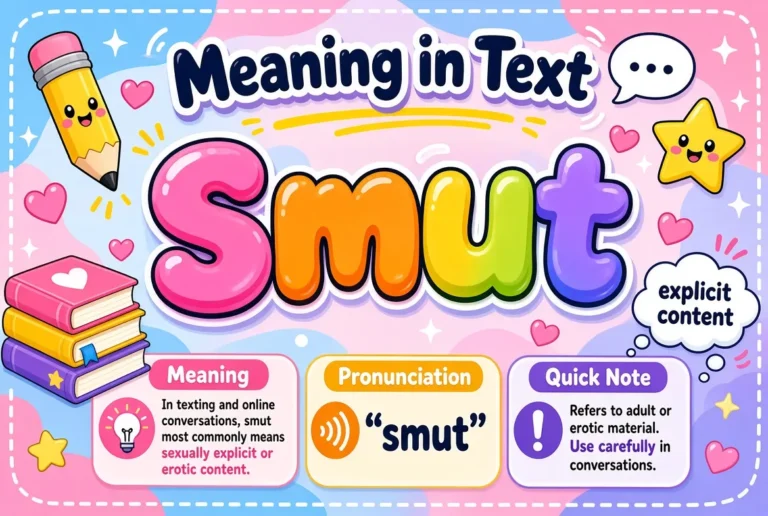
If someone used the word “smut” in a text, chat, comment, or social media post, the meaning usually depends on the conversation.
Most commonly, smut refers to sexually explicit or erotic content, especially stories, books, images, jokes, or conversations intended for adults.
However, the word is not always used as a serious warning. Friends may jokingly call a romantic book with explicit scenes “smut,” while someone else may use the term critically to describe content they consider vulgar or inappropriate.
If you are wondering what does smut mean in text, the most important clue is what the sender is discussing.
Looking at the surrounding messages, emojis, relationship, and platform can help you understand whether the term is playful, descriptive, critical, or simply referring to adult content.
Quick Answer
Smut in text usually means sexually explicit, erotic, or adult content. People often use it casually to describe books, stories, videos, jokes, or conversations containing explicit sexual material. Depending on the context, “smut” can sound playful or humorous, but it may also be used critically to describe content someone considers vulgar or inappropriate.
What Does Smut Mean in Text?
In texting and online conversations, smut most commonly means sexually explicit or erotic content.
It is not an abbreviation, so there is no full form. The word is pronounced “smuht,” rhyming with “cut.”
The term can refer to many types of content, including:
- Erotic or sexually explicit fiction
- Books containing explicit scenes
- Adult jokes or conversations
- Sexually explicit artwork or media
- Fan fiction with adult themes
The tone depends heavily on context. Among friends discussing romance novels, “smut” may be playful and completely casual. In another conversation, someone might use the word negatively to criticize content they find offensive or inappropriate.
Text example:
“I thought it was a romance novel, but the second half was basically smut 😂”
In this example, the sender means that the book contains a significant amount of sexually explicit content.
Origin and Background of Smut
“Smut” is an older English word that has had different meanings over time. In modern everyday use, however, it is widely associated with obscene, indecent, or sexually explicit material.
The word existed long before texting, social media, and online communities.
As people began discussing books, fan fiction, entertainment, and adult themes online, “smut” became a convenient informal label for sexually explicit content.
Online communities often use the word more casually than formal dictionaries or older generations might. For example, readers may jokingly describe an erotic romance novel as “smut” without necessarily meaning that the book is bad or offensive.
How Smut Is Used in Text Conversations
Talking About Books and Stories
One of the most common modern uses of “smut” is when discussing romance books, erotic fiction, or fan fiction.
Person A: “Is that book romantic?”
Person B: “Yes, but just so you know, it has a lot of smut.”
Here, the word acts as a content description or warning.
Making a Playful Joke
Friends sometimes use “smut” humorously when a conversation unexpectedly becomes suggestive.
Person A: “Why did your mind go there? 😭”
Person B: “Sorry, everything sounds like smut to me today.”
The tone here is joking and self-aware.
Referring to Explicit Fan Fiction
Online fandom communities frequently use “smut” to label fictional stories containing explicit sexual scenes.
Person A: “What are you reading?”
Person B: “Mostly smut and fan fiction tonight.”
This does not automatically mean the speaker is being inappropriate toward the person they are texting. They may simply be describing the type of fiction they enjoy reading.
Using It Critically
Sometimes “smut” is used negatively to describe material that someone considers indecent or vulgar.
Person A: “Why are they showing that?”
Person B: “I don’t know. It just feels like smut for attention.”
In this context, the sender is criticizing the content.
What Smut Means on Different Platforms
The core meaning of “smut” generally remains the same across platforms, but the type of content being discussed can vary.
On WhatsApp, “smut” usually appears in private conversations about books, jokes, media, or adult topics. Context is particularly important because the platform is commonly used for personal conversations.
Snapchat
On Snapchat, the word may appear in playful conversations or references to suggestive humor. However, seeing the word does not automatically tell you exactly what content someone intends to send or discuss.
On Instagram, people may use “smut” when discussing romance books, fan communities, writing, art, or suggestive posts. It can also appear in comments as a joke about romantic or sexually charged content.
TikTok
TikTok users may use “smut” when talking about books, especially romance and fantasy novels with explicit scenes. The term can also appear in discussions about fictional characters, fan fiction, or humorous content.
On Facebook, “smut” may be used more critically than playfully in some conversations, particularly when people are describing media they consider inappropriate. However, the meaning still depends on the speaker’s tone and community.
Discord
On Discord, the term may appear in fandom, writing, gaming, or role-playing communities. It often refers to explicit fan fiction or adult fictional content, depending on the server and its rules.
Dating Apps
On dating apps, “smut” can signal that someone is talking about sexual or explicit topics. If the conversation is becoming more sexual than you are comfortable with, you do not have to continue discussing it.
What Does Smut Mean From a Girl or Guy?
The meaning of “smut” does not automatically change depending on whether it comes from a girl or a guy.
A person’s gender does not tell you what they mean. The important clues are the relationship between you, the previous conversation, punctuation, emojis, and what the person is referring to.
For example:
“This book is pure smut 😂”
This is probably a playful comment about explicit fiction.
But:
“Want to talk about smut? 😏”
The message is more likely introducing a sexual or adult topic.
Emojis can change the tone. A laughing emoji may suggest humor, while suggestive emojis can make the message sound flirtier. Even then, context matters more than any single emoji.
Other Possible Meanings of Smut
The most common modern texting meaning is sexually explicit or erotic content. However, the word can also be used more broadly.
| Meaning | Context | Example |
|---|---|---|
| Sexually explicit or erotic content | Texting, books, fan fiction, online discussions | “That story turned into smut halfway through.” |
| Obscene or vulgar material | Criticism of media or entertainment | “He called the movie smut.” |
| Dirty or inappropriate content in a broad sense | Humorous or judgmental conversation | “My friends turned the whole conversation into smut.” |
These meanings are closely related rather than completely separate definitions. In modern casual texting, the first meaning is usually the one intended.
How to Respond to Smut
Your response should depend on whether the conversation is casual, funny, unwanted, confusing, or flirtatious.
Casual
Them: “This book has so much smut.”
You: “Good to know! Is the story actually good too?”
Funny
Them: “My brain keeps turning everything into smut 😂”
You: “Your imagination needs to calm down for five minutes 😭”
Interested but Neutral
Them: “I mostly read smut.”
You: “Oh, so you mean romance or erotic fiction?”
This is a useful response if you want clarification without making assumptions.
Confused
Them: “That show is basically smut.”
You: “What do you mean by smut here? Is it really explicit?”
Setting a Boundary
Them: “Let’s talk about smut.”
You: “I’d rather not discuss sexual topics.”
You do not need to justify your boundary.
Changing the Subject
You: “Haha, that’s not really my thing. What else have you been watching lately?”
Playful but Non-Explicit
Them: “That book is pure smut 😏”
You: “Sounds like you have very specific reading recommendations 😂”
Similar Texting Terms and Differences
| Term | Meaning | Key Difference |
|---|---|---|
| Smut | Sexually explicit or erotic content | Often used casually for books, stories, or fictional content |
| NSFW | Not Safe For Work | A warning that content may be inappropriate to view in public or professional settings |
| Spicy | Suggestive, romantic, or sexually explicit | Often softer and less direct than “smut” |
| Erotica | Literature or art intended to be sexually arousing | Usually a more specific and formal term for a genre |
| Thirsty | Showing strong attraction or desire | Describes a person’s behavior or comments rather than explicit content itself |
These terms can overlap, but they are not interchangeable. For example, a “spicy” romance novel may contain suggestive scenes without being as explicit as content someone would describe as smut.
Common Misunderstandings About Smut
One common misunderstanding is assuming that “smut” always means someone is making a sexual advance toward you. Often, the person is simply talking about a book, story, joke, or type of entertainment.
Another mistake is thinking that “smut” is always a compliment or always an insult. It can be either playful or critical.
Capitalization usually does not change the meaning:
- smut
- Smut
- SMUT
The all-capital version may simply add emphasis.
People may also use the term jokingly to exaggerate. For example, someone might call a mildly suggestive scene “smut” even if it is not especially explicit.
Is Smut Appropriate or Safe to Use?
“Smut” is an informal term connected to sexual or explicit content, so it may not be appropriate in every situation.
It is generally best avoided in:
- Professional workplaces
- Formal school communication
- Conversations with people you do not know well
- Situations involving minors
- Public conversations where sexual language may be inappropriate
The word itself is not automatically an insult or threat, but it can introduce sexual content into a conversation. Always consider whether the other person is comfortable discussing that topic.
If someone sends you explicit messages or pressures you to discuss sexual content when you have said no, it is appropriate to set a clear boundary, stop responding, or use the platform’s safety and reporting tools when necessary.
Examples of Smut in Text
- “I need a book recommendation, but nothing too heavy on the smut.”
- “Not me realizing halfway through that this romance is basically smut 😂”
- “My friend warned me about the smut before I started reading it.”
- “The plot was interesting, but there was way more smut than I expected.”
- “Stop turning every innocent conversation into smut 😭”
- “Is this book actually romantic, or is it mostly smut?”
- “I don’t mind some spicy scenes, but I wasn’t expecting full-on smut.”
- “She writes fantasy, romance, and occasionally smut.”
- “That joke sounded innocent until you made it into smut 😂”
- “The reviews keep calling it smut with a plot.”
- “I skipped that recommendation because I’m not really into reading smut.”
- “Please give me the warning before you send anything sexual or smut-related.”
Frequently Asked Questions
Is smut a bad word?
“Smut” is not generally considered a swear word, but it refers to sexually explicit or obscene material. Whether it sounds offensive depends on the context and audience. Friends discussing romance novels may use it casually, while someone else may use it as criticism.
What does smut mean in a book?
When people describe a book as “smut,” they usually mean it contains explicit sexual scenes or focuses heavily on erotic content. The word is commonly used in discussions of romance novels, erotica, and fan fiction.
Does smut always mean porn?
No. “Smut” does not always mean pornography. It can refer to sexually explicit fiction, writing, jokes, art, or other adult material. The exact type and level of explicitness depend on what the conversation is discussing.
What does “smut with a plot” mean?
“Smut with a plot” is usually a humorous description of a story that contains both a narrative and a significant amount of explicit sexual content. The phrase often suggests that the story is entertaining but that sexual scenes are a major part of it.
What does smut mean on TikTok or BookTok?
On TikTok, especially in book-related communities, “smut” commonly refers to romance or fiction containing explicit sexual scenes. Readers may use the word to discuss a book’s content level, recommend it to adults, or jokingly describe their reading preferences.
Should I be concerned if someone texts me “smut”?
Not necessarily. The sender may simply be talking about a book, movie, joke, or online content. However, if they are trying to pressure you into sexual conversations or sending explicit material you do not want, it is reasonable to set boundaries and disengage.
Conclusion
In text, smut most commonly means sexually explicit, erotic, or adult content, particularly stories, books, fan fiction, or suggestive media.
The word can sound playful among friends, descriptive in book discussions, or critical when someone considers content vulgar.
Gender does not change the meaning; the surrounding conversation, relationship, tone, and emojis provide the strongest clues.
If someone uses “smut” in a way that makes you uncomfortable, you can simply ask for clarification, change the subject, or clearly state that you do not want to discuss sexual content.

I am Ava Richardson, a passionate language writer who loves making English words and their meanings simple and easy to understand.
I create clear definitions, useful examples, and practical explanations to help readers improve their English vocabulary.