
If you have received “TB” in a message and are wondering what it means, the answer depends heavily on the conversation.
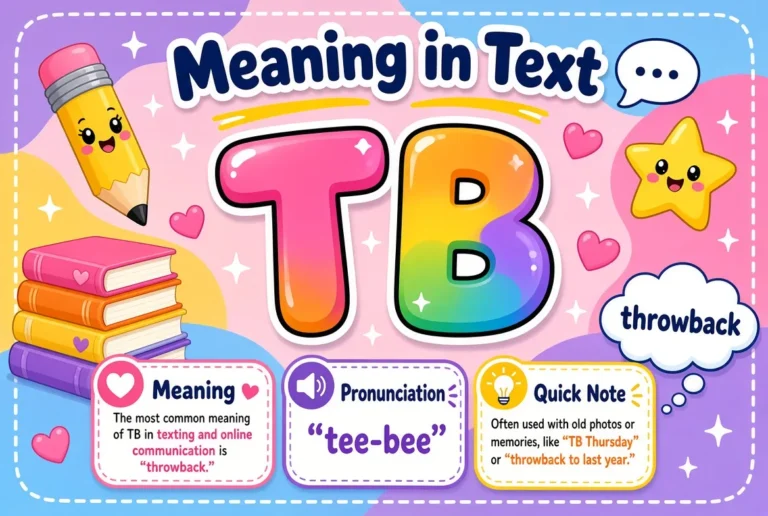
The most common meaning of TB in text is “throwback,” especially when someone is sharing or referring to an old photo, memory, event, or experience.
However, TB can also have other meanings, including “text back” or abbreviations connected to specific topics and communities.
That is why context matters. A message saying “TB to last summer” means something very different from “TB when you can.”
If you searched what is tb mean in text, this guide explains the most common meaning, genuine alternatives, platform usage, tone, examples, and natural ways to respond.
Quick Answer
TB most commonly means “throwback” in text and social media conversations. People use it when referring to an old memory, photo, event, or experience. Depending on context, TB can also mean “text back.” Look at the surrounding message to determine which meaning makes the most sense.
What Does TB Mean in Text?
The most common meaning of TB in texting and online communication is “throwback.”
A throwback is something that reminds someone of the past. It may be an old photograph, childhood memory, previous holiday, relationship moment, song, event, or funny experience.
TB is usually pronounced by saying the individual letters: “tee-bee.”
Tone and emotional meaning
When TB means “throwback,” its tone is usually:
- Casual
- Nostalgic
- Friendly
- Funny
- Sentimental
- Sometimes romantic
The emotional tone depends on what the person is remembering.
Example:
“TB to our school trip 😂 That was such a mess.”
Here, TB means the sender is remembering and referring back to an earlier school trip.
Origin and Background of TB
TB developed as a shortened form of “throwback,” which became especially common in online conversations and social media posts about old memories and photos.
The idea of sharing something from the past was already common before social media.
Online users gradually adopted shorter expressions such as TB and related phrases such as TBT, meaning “Throwback Thursday.”
There is no need to assume that TB always has one fixed historical origin in texting.
Like many abbreviations, its meaning became established through repeated informal use in digital communication.
Today, TB is often understood immediately when the conversation involves an old memory or photo.
How TB Is Used in Text Conversations
Remembering an old moment
This is one of the most natural uses of TB.
Person 1: I found pictures from our first year at college.
Person 2: TB 😭 We looked so young.
Here, TB introduces a nostalgic reaction to the past.
Referring to an old photo
Someone may send an old image and write:
“TB to 2018 😂”
This means the image is from the past and is being shared as a throwback.
Talking about a past relationship or experience
TB can sometimes appear when someone remembers a meaningful experience.
Person 1: I heard that song today.
Person 2: TB to those late-night drives 🥲
The abbreviation itself is not automatically romantic, but the memory being discussed may be.
Using TB humorously
People also use throwback references to joke about embarrassing old photos or memories.
“TB to when I thought those sunglasses looked good on me 😭”
The tone here is self-deprecating and humorous.
When TB means “text back”
In some conversations, TB can mean “text back.”
Example:
“TB when you get home.”
In this context, the sender is not talking about the past. They are asking the other person to text them back later.
This is why surrounding words are important.
What TB Means on Different Platforms
On WhatsApp, TB can mean throwback when people discuss old photos, memories, or events. In direct conversations, it may also occasionally mean text back.
Context usually makes the intended meaning clear.
Snapchat
TB commonly appears with old photos, memories, or nostalgic posts. Someone may share an older image and write:
“TB 😂”
Snapchat’s focus on photos and memories makes the throwback meaning especially easy to understand.
On Instagram, TB usually refers to throwback content.
It may appear in captions, comments, Stories, or messages. It is also related to the longer and more familiar expression TBT, or “Throwback Thursday.”
TikTok
On TikTok, TB may refer to an older trend, video, song, memory, or personal moment.
For example:
“TB to this trend because I still love it.”
The meaning generally remains the same: looking back at something from the past.
TB is often used when people share old photographs, school memories, family events, or previous holidays.
Older photos are frequently posted with expressions such as:
“TB to our family holiday.”
Discord
On Discord, TB depends more on the conversation. It may mean throwback when discussing an old game, joke, event, or memory.
Because Discord conversations can involve many communities and subjects, checking the surrounding discussion is especially important.
Dating Apps
On dating apps, TB can mean throwback when someone shares an old photo or discusses a previous experience.
For example:
“TB to my backpacking trip in Australia.”
If TB appears in a short message without context, however, asking for clarification is completely reasonable.
What Does TB Mean From a Girl or Guy?
TB does not have a different fixed meaning based on whether the sender is a girl or a guy.
The same abbreviation usually means the same thing. What changes the interpretation is the relationship between the people, the topic, punctuation, emojis, and surrounding messages.
For example:
“TB to our first date 🥹”
This may feel romantic because of the shared memory and emoji.
On the other hand:
“TB 😂😂”
after an embarrassing old photo is clearly playful.
Avoid assuming romantic interest simply because someone uses TB while remembering the past. The content of the memory provides a much stronger clue than the sender’s gender.
Other Possible Meanings of TB
Although throwback is the most common social-media and casual texting meaning, TB can have other meanings depending on context.
| Meaning | Context | Example |
|---|---|---|
| Throwback | Old photos, memories, events, or experiences | “TB to our beach holiday.” |
| Text back | Asking someone to reply later | “TB when you’re free.” |
| Tuberculosis | Medical or health discussions | “The doctor tested him for TB.” |
| To be | Rare shorthand or typing abbreviation in certain informal contexts | “TB honest, I didn’t expect that.” |
The last example is much less standard than TB = throwback or TB = text back. If someone writes “TB” in an ordinary social conversation, do not automatically assume it means “to be.”
How to Respond to TB
Your response should match the meaning and tone of the conversation.
Casual response
Them: TB to last summer.
You: Seriously! That feels like ages ago.
Friendly response
Them: TB to our school days 😂
You: Those were some unforgettable times 😂
Funny response
Them: TB to my terrible haircut 😭
You: Please tell me that photo no longer exists 😂
Nostalgic response
Them: TB to our old neighbourhood.
You: I miss those days more than I expected.
Romantic response
Them: TB to our first date 🥹
You: That was one of my favourite days with you ❤️
If TB means “text back”
Them: TB when you get home.
You: Sure, I’ll text you when I get back.
If you are confused
Them: TB 😭
You: Wait, do you mean throwback?
Asking directly is often better than guessing, especially when the message is very short.
Similar Texting Terms and Differences
| Term | Meaning | Key Difference |
|---|---|---|
| TB | Throwback | General shorthand for remembering or sharing something from the past |
| TBT | Throwback Thursday | Usually connected specifically with Thursday posts |
| FBF | Flashback Friday | Similar idea but traditionally associated with Friday |
| Nostalgia | A sentimental feeling about the past | A full word describing the emotion rather than an abbreviation |
| ICYMI | In case you missed it | Refers to something previously shared, not necessarily a personal memory |
Common Misunderstandings About TB
One of the biggest mistakes is assuming TB always means throwback.
If someone writes:
“TB when you arrive.”
the phrase probably means text back, not throwback.
Another misunderstanding involves capitalization. People may write:
- TB
- tb
- Tb
In casual texting, capitalization usually does not change the meaning. However, TB can also appear as an abbreviation in medical discussions, where it commonly refers to tuberculosis.
Spelling variations are also worth noting.
Some people may use TBT instead of TB when referring to a throwback, especially on social media.
The safest approach is to examine what appears before and after the abbreviation.
Is TB Appropriate or Safe to Use?
TB is generally informal and harmless when used to mean “throwback” or “text back.”
It is appropriate for:
- Friends
- Family chats
- Social media
- Casual online conversations
- Informal messages
It may be less suitable for professional emails or formal workplace communication because abbreviations can be unclear.
One important exception is TB meaning tuberculosis in medical discussions. In that context, it refers to a serious health topic and should be interpreted according to the conversation.
When you are unsure whether TB refers to a memory, a request to reply, or a medical subject, check the context rather than assuming.
Examples of TB in Text
- “TB to our first day at university 😂”
- “Just found this old photo. Major TB!”
- “TB to when we used to play that game every night.”
- “TB 😭 I completely forgot this happened.”
- “That song is such a TB to high school.”
- “TB to our holiday last year. I need another trip.”
- “Look what came up in my memories—TB 😂”
- “TB to my embarrassing fashion choices in 2015 😭”
- “TB when you get home so I know you’re safe.”
- “This photo is a serious TB. We were so young.”
- “TB to those late-night conversations 🥲”
- “I can’t believe this was five years ago. TB!”
Frequently Asked Questions
What does TB stand for in text?
In most casual conversations and social media posts, TB stands for throwback. It refers to an old memory, photo, event, or experience. However, TB can also mean text back when someone is asking another person to reply later, so the surrounding message is important.
Does TB mean throwback or text back?
Both meanings are possible. Throwback is common when people are discussing old memories or sharing old photos. Text back is more likely when TB appears as part of a request, such as “TB when you get home” or “TB later.”
What does TB mean on Instagram?
On Instagram, TB usually means throwback. Users may write it in captions, Stories, comments, or direct messages when sharing something from the past. It is closely related to TBT, meaning “Throwback Thursday,” although TB itself can be used on any day.
What does TB mean from someone you like?
TB usually means the same thing regardless of who sends it. If someone you like says “TB to our first date,” the message may have romantic or nostalgic meaning because of the shared memory. The relationship and conversation matter more than the abbreviation itself.
Is TB the same as TBT?
Not exactly. Both are connected to remembering the past, but TB simply means throwback, while TBT usually means Throwback Thursday. TB can be used on any day and in ordinary conversations, while TBT is more strongly associated with social media posts.
How do I know what TB means in a message?
Look at the surrounding words. References to old photos, memories, school, holidays, music, or previous events usually indicate throwback. If the message asks you to reply or contact the sender later, TB may mean text back. When context is unclear, asking is the safest option.
Conclusion
In text messages, TB most commonly means “throwback,” especially when someone is remembering an old photo, event, song, relationship moment, or experience.
Its tone can be funny, nostalgic, sentimental, or occasionally romantic depending on the memory being discussed.
In some conversations, TB can also mean “text back,” while medical discussions may use it to mean tuberculosis.
The easiest way to understand TB correctly is to check the surrounding words and the topic of the conversation.
When in doubt, a quick question can prevent misunderstandings.

I am Ava Richardson, a passionate language writer who loves making English words and their meanings simple and easy to understand.
I create clear definitions, useful examples, and practical explanations to help readers improve their English vocabulary.