
If you have received a message containing “PIN” and are wondering what it means, the answer depends heavily on the conversation.
Unlike many texting abbreviations, PIN is usually not a slang acronym with one fixed meaning.
In text messages and social media conversations, it often refers to a personal identification number, a location pin, or the act of pinning something so it remains easy to find.
For example, someone might ask, “What’s the Wi-Fi PIN?” while another person might say, “Send me your pin,” meaning their location.
On apps such as Snapchat, Instagram, Discord, and WhatsApp, “pin” can also refer to keeping a message, chat, or post visible.
So, when asking what does pin mean in text, the surrounding words usually provide the clearest answer.
Quick Answer
PIN in text most commonly means “Personal Identification Number,” a secret number used for security or access. However, depending on the conversation, “pin” can also mean a location pin or the action of saving a message, chat, or post in a prominent place. Context tells you which meaning applies.
What Does PIN Mean in Text?
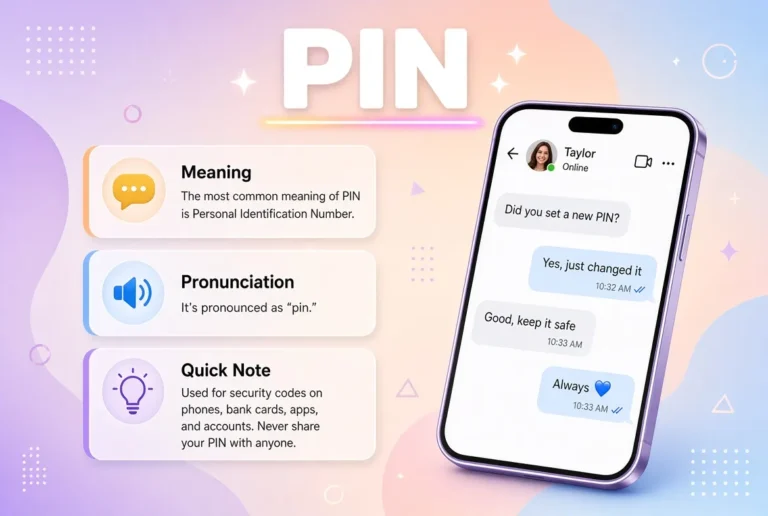
The most common meaning of PIN is Personal Identification Number.
A PIN is usually a short number used to verify someone’s identity or provide access to something, such as a bank card, phone, account, door, or other protected service.
It is usually pronounced by saying the individual letters: P-I-N.
Tone and emotional meaning
PIN itself is neutral. It does not normally express an emotion, attitude, or relationship signal. The meaning comes from the topic being discussed.
For example:
Friend: “Do you remember your card PIN?”
You: “Yeah, I remember it.”
However, in casual messaging, lowercase pin may mean something completely different:
“Send me your pin when you get there.”
Here, pin most likely means a location pin rather than a security number.
Origin and Background of PIN
PIN comes from the phrase Personal Identification Number, which has long been used for security and identity verification.
As mobile phones, digital banking, maps, and social media became part of everyday communication, the word pin developed additional common uses. People now use it to describe dropping a location pin on a map or pinning a message, chat, image, or post so it stays easy to find.
The modern texting uses therefore come mainly from the everyday digital functions associated with the word rather than from a single piece of internet slang.
How PIN Is Used in Text Conversations
The meaning of PIN usually becomes clear from the words around it.
Talking about security or access
This is the most traditional meaning.
Person 1: “The machine is asking for my PIN.”
Person 2: “Make sure nobody can see you entering it.”
Here, PIN means a Personal Identification Number.
Asking for a location
People sometimes shorten “location pin” to simply pin.
Friend: “Where are you meeting us?”
You: “I’ll send you my pin.”
This means the person will send their location through a map or messaging app.
Referring to a pinned message or chat
On many apps, users can pin important conversations or messages.
Person 1: “Where did you post the meeting details?”
Person 2: “I pinned the message.”
This means the message was kept in a visible or easy-to-find position.
Casual and friendly use
“Send your pin” is common between friends arranging a meeting.
Friend: “I’m almost there. Drop your pin.”
You: “Sending it now.”
Romantic or relationship-related use
The word itself does not have a romantic meaning, but the context can be personal.
Partner: “Send me your location pin when you get home.”
You: “Okay, I will ❤️”
The emotional tone comes from the relationship and surrounding message, not from the word pin itself.
Humorous or sarcastic use
PIN can occasionally be used jokingly.
Friend: “What’s your phone PIN?”
You: “Nice try 😂”
The joke is about refusing to share private security information.
What Does PIN Mean on Different Platforms?
The basic meanings of PIN remain similar, but different apps make certain meanings more common.
On WhatsApp, pin may refer to:
- Sending a location pin
- Pinning a chat
- Pinning an important message
For example, “Send your pin” often means sending your location.
Snapchat
On Snapchat, pin may refer to a pinned conversation or location-related information. The exact meaning depends on whether the conversation is about chats, friends, or meeting somewhere.
On Instagram, users may use pin when discussing pinned posts, comments, or shared locations.
For example:
“Pin this comment.”
This means keeping the comment prominently displayed.
TikTok
On TikTok, pin commonly refers to pinning a comment so viewers can easily see it.
A creator might say:
“I pinned the answer in the comments.”
On Facebook, pin often refers to pinning a post, comment, or important information so it remains visible.
Discord
On Discord, pinned messages are commonly used to save important information in a channel.
For example:
“Check the pins for the server rules.”
Dating Apps
On dating apps, send me your pin usually means send me your location. However, people should still be careful about sharing their exact location with someone they do not know well.
What Does PIN Mean From a Girl or Guy?
PIN does not automatically change meaning depending on whether it comes from a girl or a guy.
The important clues are:
- What was being discussed before the message?
- Is the conversation about money, a phone, or security?
- Are you arranging to meet somewhere?
- Is the person talking about an app or social media feature?
- Are emojis or punctuation changing the tone?
For example:
“What’s your PIN?”
This could mean a security code, although sharing one is usually unsafe.
“Send me your pin 😊”
This is more likely to mean a location pin, especially when two people are arranging to meet.
Relationship context can affect how personal the request feels, but it does not change the basic definition of the word.
Other Possible Meanings of PIN
| Meaning | Context | Example |
|---|---|---|
| Personal Identification Number | Security, banking, phones, accounts | “Enter your PIN to continue.” |
| Location pin | Maps and meeting places | “Send me your pin so I can find you.” |
| Pinned message or chat | Messaging and social media apps | “I pinned the instructions.” |
| To pin something in place | General conversation | “Pin the photo to the board.” |
| A physical pin | Clothing, decorations, or objects | “I lost my jacket pin.” |
The most common meaning when PIN is written in uppercase is Personal Identification Number. In casual lowercase texting, location or app-related meanings are also very common.
How to Respond to PIN in Text
Your response should match what the sender means.
If they mean a security PIN
“I remember it, thanks.”
Example:
Friend: “Don’t forget your PIN.”
You: “I won’t. I’ve got it.”
Never share a sensitive PIN unless there is a legitimate and secure reason to do so.
If they mean your location
“Sure, I’ll send my location pin now.”
Example:
Friend: “Send your pin.”
You: “Yep, sending it.”
If you are unsure
“Do you mean my location pin or my security PIN?”
This is a useful response when the message lacks context.
If they ask for private information
“I don’t share my PIN with anyone.”
This is clear and appropriate.
A friendly response
“Got it! I’ll send the pin when I arrive.”
A funny response
“Nice try 😂 My PIN is classified information.”
A romantic response
“Of course ❤️ I’ll send you my location when I get there.”
A serious response
“Please don’t send your banking or card PIN through messages.”
Similar Texting Terms and Differences
| Term | Meaning | Key Difference |
|---|---|---|
| PIN | Personal Identification Number or another context-based meaning | Usually relates to security, location, or pinned content |
| OTP | One-Time Password | Usually temporary and valid for a short period |
| Passcode | Code used to unlock or access something | Can contain numbers, letters, or symbols |
| Location | Where someone currently is | More general than a map pin |
| Drop a pin | Send or mark a specific location | Specifically refers to a map location |
A PIN and an OTP should not be confused. A PIN is often created and remembered by the user, while an OTP is generally generated for temporary verification.
Common Misunderstandings About PIN
One common mistake is assuming that PIN always means Personal Identification Number.
Consider this message:
“Drop your pin.”
This almost certainly does not mean “send me your security number.” It usually means, “Send me your location.”
Capitalization can sometimes provide a clue. PIN is more likely to refer to the formal abbreviation Personal Identification Number, while pin may be used as an ordinary word.
However, capitalization is not always reliable because people often type quickly or use autocorrect.
Another misunderstanding is assuming that a request for “your PIN” is always harmless. If someone is asking for a banking, card, phone, or account PIN, you should be cautious. Legitimate organizations generally do not need you to send sensitive PIN information through ordinary messages.
Is PIN Appropriate or Safe to Use?
PIN is a neutral and appropriate word in most conversations. It is not rude, offensive, or inherently sensitive.
However, safety depends on which type of PIN is being discussed.
Security PINs
Never casually share:
- Bank card PINs
- ATM PINs
- Phone unlock PINs
- Account security codes
- Other private authentication information
If someone pressures you to share a private PIN, treat the request carefully.
Location pins
Sharing a location pin can be convenient, but it may reveal where you are. Be cautious when sharing your live or exact location with strangers or people you do not fully trust.
Pinned messages and posts
Using “pin” to describe a message, chat, post, or comment is generally harmless and workplace-appropriate when used in the correct context.
Examples of PIN in Text
- “Do you remember the PIN for your card?”
- “Send me your pin when you get to the restaurant.”
- “I pinned the address so nobody loses it.”
- “Wait, are you asking for my location pin or my phone PIN?”
- “Check the pinned messages for the homework instructions.”
- “I’ll drop my pin once I find the entrance.”
- “Never send your bank PIN to anyone.”
- “Can you pin that message? I need to find it later.”
- “My map pin shows the wrong side of the building 😭.”
- “The app keeps asking me to enter my PIN.”
- “I pinned our chat because we talk every day.”
- “Send your location pin, and I’ll meet you there.”
Frequently Asked Questions
What does “send me your pin” mean in a text?
Most often, “send me your pin” means send me your location pin. The sender usually wants to know where you are or where you want to meet. If the conversation is about banking, phones, or security, however, they may mean a Personal Identification Number, so context is important.
Does PIN always mean Personal Identification Number?
No. Although Personal Identification Number is the formal and traditional meaning of PIN, casual messages may use “pin” to mean a map location or a pinned message. Read the surrounding conversation before deciding which meaning applies.
What does “drop your pin” mean?
“Drop your pin” usually means send your location through a map or messaging service. It is a casual expression commonly used when people are trying to meet or help someone find a specific place.
Is it safe to send someone my PIN?
It depends on the meaning. Sending a location pin may be fine if you trust the recipient. You should generally never send a bank card, ATM, account, or other security PIN through a text message.
What does “pin the message” mean?
“Pin the message” means marking a message so it stays easy to find or remains prominently displayed. Many messaging platforms allow users to pin important information, announcements, instructions, or conversations.
Why did someone write PIN in capital letters?
Writing PIN in capital letters often suggests the person means Personal Identification Number, because it is an abbreviation. However, people do not always follow capitalization rules in texting, so the conversation’s context remains the most reliable clue.
Conclusion
PIN has several common meanings in text, but Personal Identification Number is the most traditional meaning.
In everyday messaging, however, “pin” may also mean a location pin or the action of pinning a message, chat, comment, or post.
The best way to understand it is to look at the surrounding conversation. Security-related topics usually point to a Personal Identification Number, while plans to meet often involve a location pin.
If the message is unclear, simply ask what kind of pin the sender means.

I am Ava Richardson, a passionate language writer who loves making English words and their meanings simple and easy to understand.
I create clear definitions, useful examples, and practical explanations to help readers improve their English vocabulary.