
The search phrase “what does mean in a text message” is incomplete because the specific word, abbreviation, emoji, or symbol is missing.
In a text conversation, “mean” usually refers to the definition or intended interpretation of something another person sent.
For example, someone may ask, “What does ‘wyd’ mean in a text message?” or “What does this emoji mean?” The answer depends entirely on the exact term being discussed and the context surrounding it.
Text messages can also change meaning through punctuation, emojis, tone, relationship, and previous messages.
A short reply may be friendly, sarcastic, romantic, confused, or serious depending on how it is used.
This guide explains what people usually mean when asking about the meaning of something in a text message and how to interpret it accurately.
Quick Answer
Quick Answer: In a text message, “mean” refers to what a word, abbreviation, emoji, symbol, or message is intended to communicate. There is no single meaning without knowing the exact term or message. Context, tone, punctuation, emojis, and the relationship between the people texting can all affect interpretation.
What Does “Mean” Refer to in a Text Message?
The word mean is not usually a texting abbreviation with one special definition. It is a common English word used when asking about the meaning or intended message behind something.
When someone asks:
“What does this mean in a text message?”
They are usually asking:
- What does this word mean?
- What does this abbreviation stand for?
- What is this person trying to say?
- Is there a hidden or emotional meaning?
- Is the message friendly, romantic, sarcastic, or negative?
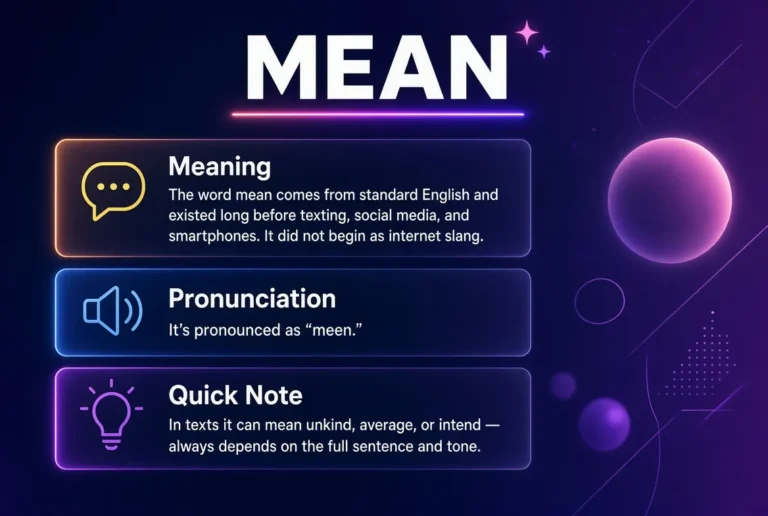
The pronunciation is meen.
Simple definition
Mean = to communicate, represent, or express a particular idea or intention.
Tone and emotional meaning
The word itself is neutral. However, the message being interpreted may have many possible tones.
For example:
Person A: “K.”
Person B: “What does that mean?”
In this situation, Person B may be wondering whether “K” simply means “okay” or whether it sounds annoyed, distant, or dismissive.
Origin and Background of the Expression
The word mean comes from standard English and existed long before texting, social media, and smartphones. It did not begin as internet slang.
However, texting has made questions about meaning more common because digital communication often removes clues available in face-to-face conversations. People cannot always hear someone’s voice or immediately see their facial expression.
As a result, readers may ask what a short reply, abbreviation, emoji, punctuation mark, or reaction means in a particular conversation.
There is no single special texting origin for the word mean itself.
How “Meaning” Is Interpreted in Text Conversations
The meaning of a message depends on more than the words alone. People often use context to understand what another person intends.
Friendly use
Person A: “You did great today!”
Person B: “Aww, that means a lot 😊”
Here, “means a lot” expresses appreciation and emotional importance.
Casual use
Person A: “wyd?”
Person B: “What does that mean?”
Person B is simply asking for the definition of an abbreviation.
Confused use
Person A: “Sure…”
Person B: “What do you mean by that?”
The punctuation may make the message sound uncertain or suggest that there is more behind the response.
Romantic or emotional use
Person A: “I miss talking to you.”
Person B: “What does that mean?”
The question may be asking whether the sender is expressing friendship, romantic interest, or something else.
Sarcastic or humorous use
Person A: “Wow, you’re so helpful 😂”
Person B: “What does that mean? 😂”
Depending on the conversation, both people may understand that the message is playful sarcasm.
Negative or serious use
Person A: “Don’t worry about it.”
Person B: “What do you mean?”
In a serious conversation, the person asking may be seeking clarification rather than making a joke.
What “Mean” Refers to on Different Platforms
The basic meaning of mean does not change significantly between platforms. What changes is the type of communication people are trying to interpret.
On WhatsApp, people may ask what an abbreviation, reaction, emoji, voice-note comment, or short reply means.
For example:
“What does ‘seen’ mean here?”
The answer may depend on the conversation and message status.
Snapchat
On Snapchat, users may ask about slang, emojis, streak-related symbols, or short replies. Context can be especially important because conversations are often casual and fast-moving.
On Instagram, people commonly ask about the meaning of comments, DMs, emojis, abbreviations, and reactions.
A comment may also have a joking or sarcastic meaning that depends on the post itself.
TikTok
TikTok users frequently encounter new slang, shortened expressions, memes, and phrases that may not be obvious outside a particular video or community.
The same term can sometimes have a platform-specific trend meaning, so the video context matters.
On Facebook, “mean” may refer to the meaning of a comment, emoji, abbreviation, or message. Older and younger users may also interpret certain internet expressions differently.
Discord
Discord conversations often contain gaming terms, community-specific language, abbreviations, and jokes. A term’s meaning may depend heavily on the server or topic.
Dating Apps
On dating apps, people often ask what a message means because they are trying to understand the sender’s level of interest.
For example, a short message such as “maybe sometime” may have a different implication depending on the rest of the conversation.
What Does It Mean From a Girl or Guy?
The basic definition of a word or abbreviation does not automatically change because it comes from a girl or a guy.
What matters more is:
- Your relationship with the person
- The previous conversation
- Their usual texting style
- Punctuation
- Emojis
- Timing
- Whether they are joking or serious
- Whether the message is part of flirting or a casual conversation
For example, “I miss you ❤️” may sound romantic in one relationship but friendly in another.
Likewise, a short reply such as “okay” may simply mean agreement from one person, while another person may use it when they are annoyed. Avoid assuming meaning based only on gender.
Other Possible Meanings of “Mean” in Text
The word mean has several genuine uses in English. In texting, context shows which one applies.
| Meaning | Context | Example |
|---|---|---|
| To signify or communicate | Asking for a definition or intention | “What does that mean?” |
| To intend | Explaining what someone was trying to say | “I didn’t mean to upset you.” |
| Important or emotionally valuable | Expressing appreciation | “Your message means a lot to me.” |
| Unkind or unpleasant | Describing someone’s behavior | “That was mean.” |
| Average in mathematics | Academic or numerical context | “The mean score was 75.” |
The most common meaning in questions about text messages is “to signify or communicate.”
How to Respond When Someone Asks “What Does That Mean?”
Your response should depend on what the person is asking about.
1. Casual clarification
“It just means ___.”
Example:
A: “What does ‘brb’ mean?”
B: “It just means ‘be right back.’”
2. Explain your intention
“I meant that I was just joking.”
This is useful when someone misunderstands your tone.
3. Give context
“It depends on the conversation, but here it probably means ___.”
This works well for slang and emojis with multiple interpretations.
4. Friendly reassurance
“Nothing bad—I meant it in a friendly way 😊.”
This can help when your message sounded more serious than intended.
5. Romantic clarification
“I meant that I genuinely enjoy talking to you.”
Use this when the conversation involves feelings or possible flirting.
6. Admit unclear wording
“Sorry, I wasn’t very clear. What I meant was ___.”
This is direct and helpful.
7. Ask for more context
“Can you send me the full message? The meaning depends on context.”
This is often the best response when a single word or emoji is not enough.
8. Funny response
“It means exactly what you think it means 😂.”
This works only when both people are clearly joking.
Similar Texting Expressions and Their Differences
| Term or Expression | Meaning | Key Difference |
|---|---|---|
| What do you mean? | Asking someone to explain | Requests clarification directly |
| What does that mean? | Asking about meaning | Often asks about a specific word, message, or action |
| I mean | Clarifying a statement | Used to explain or correct yourself |
| You mean? | Checking understanding | Often expresses surprise or confirmation |
| What are you trying to say? | Asking for intended meaning | Can sound more direct or confrontational |
Common Misunderstandings
One common mistake is assuming that every word has a secret texting meaning. “Mean” is usually just a normal English word, not slang.
Another misunderstanding is interpreting a message without enough context. A word may have one dictionary definition but communicate a different tone in a conversation.
Capitalization usually does not change the basic meaning:
- “what do you mean?”
- “What do you mean?”
- “WHAT DO YOU MEAN?”
However, the final version may appear more intense because all capital letters can suggest shouting or strong emotion.
Punctuation can also affect tone:
- “What do you mean?” — neutral question
- “What do you mean…” — confused or suspicious
- “WHAT DO YOU MEAN?!” — strong surprise or anger
Is “Mean” Appropriate or Safe to Use?
The word mean is generally polite and safe to use. It is a normal English word and is appropriate in casual conversations, education, and most professional situations.
However, the phrase surrounding it can affect the tone.
For example:
- “What do you mean?” can be neutral.
- “What do you mean by that?” may sound suspicious.
- “What do you mean?!” may sound angry.
- “That was mean.” can criticize someone’s behavior.
The word itself does not suggest self-harm, abuse, threats, or sexual content. Still, if you are trying to interpret a message containing concerning language, it is important to look at the full conversation rather than focusing on one word alone.
Examples of “Mean” in Text Messages
- “What does that mean? I’m confused 😅”
- “I didn’t mean it like that, sorry.”
- “Wait, what do you mean by ‘later’?”
- “Aww, your message really means a lot to me ❤️”
- “Lol, I was joking. I didn’t mean it seriously.”
- “What do you mean? I thought we agreed already.”
- “Don’t worry, I know what you mean 😂.”
- “That was kind of mean, honestly.”
- “When you say ‘we should hang out,’ what exactly do you mean? 👀”
- “I mean, you can come if you want.”
- “Sorry, I didn’t mean to sound rude.”
- “Do you mean tomorrow morning or tomorrow night?”
Frequently Asked Questions
What does “mean” mean in a text message?
In a text message, mean usually refers to what a word, phrase, abbreviation, emoji, or message is intended to communicate. If someone asks, “What does that mean?” they are asking for clarification about the message’s definition, intention, or emotional meaning.
Does “what do you mean?” sound rude in a text?
Not necessarily. It can be completely neutral when someone genuinely needs clarification. However, punctuation, capital letters, and the surrounding conversation can make it sound confused, annoyed, suspicious, or confrontational.
Does “mean” have a special slang meaning?
Usually, no. “Mean” is a standard English word rather than a specific piece of texting slang. However, it can appear in conversations about slang when someone asks what another abbreviation or expression means.
Why does context matter when interpreting a text message?
Text messages do not always include voice tone or facial expressions. The same words can therefore sound friendly, sarcastic, romantic, or negative depending on previous messages, punctuation, emojis, and the relationship between the people communicating.
Does the meaning change on Snapchat, Instagram, or WhatsApp?
The basic meaning of mean remains the same across platforms. What can change is the slang, emojis, trends, or community-specific language that someone is trying to interpret.
Can I know what a text means from one word alone?
Sometimes, but not always. Many abbreviations have common definitions, while emojis and short responses can depend heavily on context. Looking at the messages before and after the term usually provides a more accurate interpretation.
Conclusion
When people search “what does mean in a text message,” they are usually trying to understand the definition or intention behind a word, abbreviation, emoji, or message.
The word mean itself is standard English and usually refers to what something communicates or signifies.
To interpret a text accurately, consider the full conversation, punctuation, emojis, tone, relationship, and platform context.
If the meaning remains unclear, the simplest and most reliable response is often to ask the sender directly what they meant.

I am Ava Richardson, a passionate language writer who loves making English words and their meanings simple and easy to understand.
I create clear definitions, useful examples, and practical explanations to help readers improve their English vocabulary.