
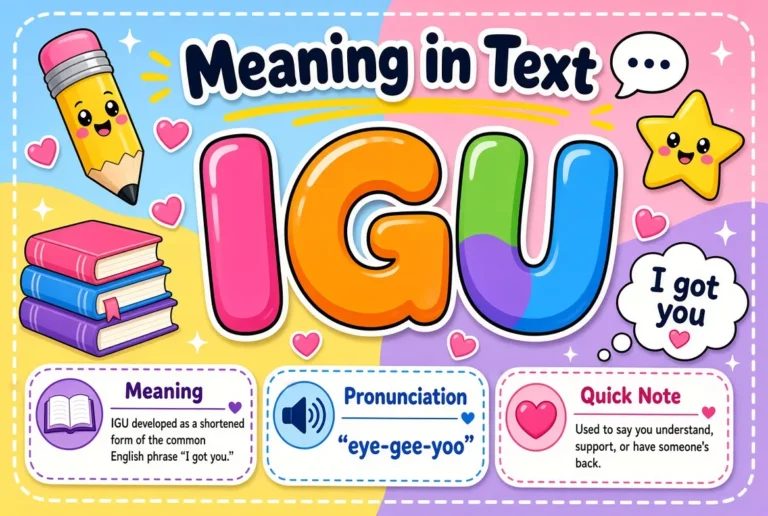
If you have received “IGU” in a text, Snapchat message, Instagram DM, or online conversation, you may be wondering what the sender meant.
In most texting slang, IGU usually means “I Got You.”
It is a casual way of telling someone that you understand them, will help them, support them, or will take care of something.
However, the exact meaning can depend on the conversation.
“I got you” can mean “I understand,” “I’ll help you,” “I’m with you,” or “don’t worry, I’ll handle it.” The tone often makes the intended meaning clear.
If you searched what does igu mean in text slang, this guide explains the most common meaning, possible interpretations, examples, platform usage, and natural ways to respond.
Quick Answer
IGU most commonly means “I Got You” in text slang. People use it to show understanding, support, agreement, or willingness to help. Depending on the conversation, it can mean “I understand,” “I’ll take care of it,” or “I’m here for you.”
What Does IGU Mean in Text?
IGU means “I Got You.”
It is an informal abbreviation made from the first letters of each word. People often use it when they want to respond quickly and casually.
The phrase can have several closely related meanings:
- I understand you
- I understand what you mean
- I’ll help you
- Don’t worry, I’ll handle it
- I’m supporting you
There is no special pronunciation because people usually read IGU as the letters “I-G-U” or simply understand it as shorthand for “I got you.”
Tone and emotional meaning
IGU is usually friendly and reassuring. It can make a conversation feel supportive because the sender is telling the other person that they are understood or that help is available.
Example:
Friend: Can you send me the notes from today’s class?
You: Yeah, IGU.
Here, IGU means “I got you—I’ll take care of it.”
Origin and Background of IGU
IGU developed as a shortened form of the common English phrase “I got you.”
The full phrase has been used in spoken English for different purposes, including expressing understanding, support, protection, or willingness to help.
As texting, social media, and instant messaging encouraged faster communication, people began shortening common phrases into initials. IGU follows the same pattern as many other texting abbreviations.
There is no single confirmed origin date or person responsible for creating IGU. Its meaning is generally understood through the longer phrase and the surrounding conversation.
How IGU Is Used in Text Conversations
The meaning of IGU depends mainly on what was said immediately before it.
Casual support
A person may use IGU when someone asks for a small favour.
A: Can you save me a seat?
B: IGU.
This means: “Yes, I’ll save you one.”
Showing understanding
IGU can also mean that the sender understands someone’s feelings or point of view.
A: I’ve been really stressed about my exams lately.
B: IGU. That sounds exhausting.
Here, IGU means something close to “I understand.”
Offering help
Sometimes it means the sender is ready to take responsibility.
A: I don’t know how to fix this.
B: Don’t worry, IGU.
The meaning is: “Don’t worry, I’ll help or handle it.”
Friendly reassurance
IGU can make a simple response sound warmer and more supportive.
A: I might need someone to talk to later.
B: Of course. IGU.
In this context, the sender is saying: “I’m here for you.”
Humorous or confident use
People may also use IGU playfully when promising to do something.
A: You better not forget my fries.
B: Relax 😂 IGU.
The meaning is still “I got you,” but the tone is playful.
Sarcastic use
IGU can occasionally be sarcastic, although this depends heavily on the conversation.
A: So you’re definitely going to finish the whole project tonight?
B: Yeah yeah, IGU 😅
The emoji and context may suggest the person is joking or being less serious than the words alone imply.
What Does IGU Mean on Different Platforms?
The basic meaning of IGU usually stays the same across platforms. The surrounding conversation matters more than the app itself.
On WhatsApp, IGU commonly means “I got you” when confirming that you understand something or will do a favour.
Snapchat
On Snapchat, it may appear in casual conversations between friends. It can mean “I understand,” “I’ll help,” or “I’m with you.”
In Instagram DMs, IGU can be used when responding to a story, conversation, request, or personal situation. The relationship between the people can affect whether it sounds simply friendly or more emotionally supportive.
TikTok
In comments and direct messages, IGU may be used to express understanding or agreement with someone’s situation.
Facebook users may use IGU in Messenger or casual comments, although the abbreviation may be less familiar to people who do not regularly use texting slang.
Discord
On Discord, IGU can mean “I understand” or “I’ll handle it,” especially in quick conversations between friends or gaming communities.
Dating Apps
On dating apps, IGU usually still means “I got you.” Depending on the conversation, it may sound supportive, reassuring, or slightly affectionate. The abbreviation itself is not automatically romantic.
What Does IGU Mean From a Girl or Guy?
IGU has no different fixed meaning based on whether it comes from a girl or a guy.
The same abbreviation can be friendly, supportive, casual, affectionate, or playful depending on the relationship and conversation.
For example:
“Don’t worry, IGU ❤️”
The heart emoji may make the message feel warmer or more affectionate.
Meanwhile:
“IGU bro 👍”
This clearly sounds casual and friendly.
To understand the intended tone, look at:
- What was discussed before the message
- Whether the sender offered help or support
- The punctuation used
- Emojis or GIFs
- Your relationship with the sender
- Whether the conversation has a romantic tone
The abbreviation alone does not reveal romantic interest.
Other Possible Meanings of IGU
In texting, “I Got You” is by far the most likely meaning of IGU. However, abbreviations can occasionally have other meanings in specialised communities or unrelated contexts.
| Meaning | Context | Example |
|---|---|---|
| I Got You | General texting and social media; the most common meaning | “Need help with that? IGU.” |
| I understand you | Emotional or conversational context | “IGU, that situation would annoy me too.” |
| I’ll handle it / I’ll help | Responding to a request | “You focus on driving. IGU with the directions.” |
These are closely related uses of the same phrase rather than completely separate definitions.
If IGU appears in a technical, academic, business, or specialised discussion, check the surrounding subject because an abbreviation can occasionally have a field-specific meaning.
How to Respond to IGU
Your reply should match what the sender means by “I got you.”
If they are offering help
Them: IGU, I’ll send it tonight.
You: Thanks, I really appreciate it!
If they understand you
Them: IGU. That situation sounds frustrating.
You: Exactly! I’m glad you understand.
If they are reassuring you
Them: Don’t stress about it, IGU.
You: Thank you, that makes me feel better.
Casual reply
You: Bet, thanks!
Friendly reply
You: Appreciate you!
Funny reply
You: Good, because I’m holding you to that 😂
Supportive reply
You: Same here. IGU too.
If you are confused
You: IGU as in “I got you”?
Asking for clarification is perfectly natural when the context is unclear.
Similar Texting Terms and Differences
| Term | Meaning | Key Difference |
|---|---|---|
| IGU | I Got You | Can show understanding, support, or willingness to help |
| IYKYK | If You Know, You Know | Refers to shared knowledge or an inside understanding |
| IKR | I Know, Right? | Expresses strong agreement |
| I Gotchu / Gotchu | I Got You | A more phonetic or informal version of the same idea |
| FWIW | For What It’s Worth | Adds an opinion or perspective rather than offering help |
IGU and “gotchu” are especially similar. Both usually communicate some form of understanding, support, or reassurance.
Common Misunderstandings About IGU
One common mistake is assuming that IGU always means “I understand.” While it can mean that, it may instead mean “I’ll help you” or “I’ll take care of it.”
For example:
A: Can you pick me up after work?
B: IGU.
Here, “I understand you” would not make much sense. The likely meaning is “Yes, I’ll do that.”
Capitalisation usually does not change the meaning:
- IGU
- igu
- Igu
In informal messages, all three may represent the same abbreviation.
Another possible misunderstanding comes from reading too much into the emotional tone. IGU is not automatically romantic. Emojis, previous messages, and the relationship between the people are much more useful clues.
Is IGU Appropriate or Safe to Use?
IGU is generally informal, friendly, and harmless in ordinary conversations.
It is appropriate for:
- Texting friends
- Social media messages
- Casual group chats
- Informal online communities
It may be less suitable for:
- Formal business emails
- Academic writing
- Professional reports
- Conversations where clear and formal language is required
The abbreviation itself is not offensive, sexual, threatening, or associated with self-harm or abuse.
However, the full phrase can sometimes appear in emotionally important conversations. For example, if someone says, “I’m really struggling, but IGU,” context may matter more than the abbreviation itself. If a conversation suggests someone is in immediate danger or serious distress, respond to the situation directly rather than focusing only on slang.
Examples of IGU in Text
- “You need the assignment notes? IGU.”
- “Don’t worry about bringing snacks. IGU 😂”
- “IGU, that would annoy me too.”
- “Running late, but IGU with the ride home.”
- “Thanks for listening.”
“Always. IGU.” - “Can you keep this between us?”
“Yeah, IGU.” - “I’m nervous about tomorrow.”
“I know. IGU ❤️” - “Bro, you forgot your charger again.”
“I know 😭 IGU next time.” - “Need someone to explain this level to me.”
“IGU, join my lobby.” - “I can’t deal with the presentation slides tonight.”
“Send them over. IGU.” - “You understand what I mean, right?”
“Yeah, IGU completely.” - “Save me a spot if you get there first.”
“For sure, IGU.”
Frequently Asked Questions
What does IGU mean in a text message?
IGU most commonly means “I Got You.” Depending on the conversation, it can mean that someone understands you, supports you, will help you, or plans to take care of something you asked them to do.
Is IGU the same as “I understand”?
Sometimes. If someone is describing a feeling, opinion, or experience, IGU may mean “I understand you.” However, when responding to a request or favour, it more often means “I’ll help” or “I’ll handle it.”
What does “IGU” mean from a friend?
From a friend, IGU usually has a supportive and casual meaning. Your friend may be saying that they understand you, have your back, or are willing to help with something.
Is IGU romantic?
Not by itself. IGU can appear in romantic conversations, but the abbreviation simply means “I got you.” Romantic interest depends on the wider conversation, relationship, affectionate language, and emojis rather than the abbreviation alone.
How do you reply when someone says IGU?
You can reply with “Thanks!”, “Appreciate you!”, “Bet!”, or “Same, I got you too.” If you are unsure what the person means, you can naturally ask, “You mean you got me?” or “IGU as in you’ll handle it?”
Is IGU rude or offensive?
No. IGU is generally not rude or offensive. It is simply an informal texting abbreviation. However, because it is casual slang, it may not be appropriate in formal professional or academic communication.
Conclusion
IGU most commonly means “I Got You” in text slang.
It is a flexible expression that can show understanding, offer help, provide reassurance, or communicate support.
The best way to understand its exact meaning is to look at the message before it and the overall tone of the conversation.
IGU is usually friendly and informal rather than romantic or rude. If someone says it after you ask for help, they are probably saying they will handle it.
If they say it after you share your feelings, they may simply mean they understand and support you.

I am Ava Richardson, a passionate language writer who loves making English words and their meanings simple and easy to understand.
I create clear definitions, useful examples, and practical explanations to help readers improve their English vocabulary.