
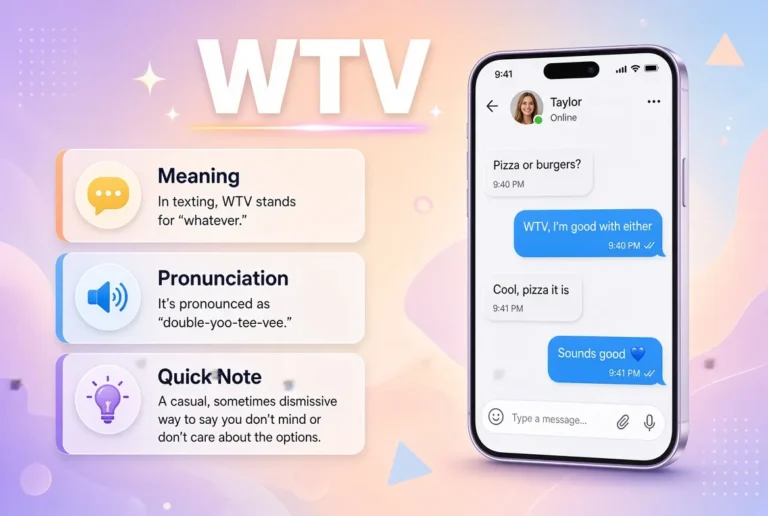
If you have received a message containing “wtv” and wondered what the sender meant, the answer is usually simple.
In texting and social media conversations, wtv is a casual abbreviation for “whatever.”
However, its tone can change significantly depending on the conversation.
Someone might use it in a relaxed way when they have no preference, such as “Wtv you want is fine.”
In another situation, “wtv” can sound dismissive, annoyed, sarcastic, or uninterested.
That is why context matters when trying to understand what does wtv mean in text messages.
Below, you will find the most common meaning of wtv, how people use it on different platforms, what it can mean from a girl or guy, how to respond, and examples that show the difference between friendly and negative uses.
Quick Answer
WTV usually means “whatever” in text messages. People use it when they do not have a preference, want to sound casual, or are dismissing something. Depending on the context, “wtv” can sound relaxed and friendly, but it may also suggest annoyance, sarcasm, or a lack of interest.
What Does WTV Mean in Text?
In texting, WTV stands for “whatever.”
It is a shortened version of the word whatever, used to make messages quicker and more casual.
People may write it in lowercase (wtv) or uppercase (WTV), and the meaning is generally the same.
It is usually pronounced as “whatever,” rather than saying each letter separately.
The emotional tone depends heavily on the surrounding conversation.
For example:
Alex: Should we watch a movie or play a game?
Sam: Wtv, I’m good with either.
Here, wtv simply means that Sam has no strong preference.
Compare that with:
Alex: I already explained why I was late.
Sam: Wtv.
In this situation, wtv may sound dismissive or annoyed.
Origin and Background of WTV
WTV developed naturally as part of informal online and mobile communication, where people often shorten common words and phrases to type more quickly.
“Whatever” is a long and frequently used conversational word, so removing most of its letters creates the convenient abbreviation wtv.
Like many texting abbreviations, its exact first use is difficult to trace to one person, website, or date. Its popularity grew through casual messaging, online chats, social media, and other fast-paced digital conversations.
Today, wtv is widely understood by many English-speaking internet users, although some people—especially those less familiar with texting slang—may prefer the full word.
How WTV Is Used in Text Conversations
WTV can communicate several slightly different attitudes. The surrounding words, punctuation, and relationship between the people involved usually reveal the intended meaning.
Casual and Indifferent Use
Sometimes, wtv simply means “anything is fine” or “I don’t mind.”
Friend: Pizza or burgers?
You: Wtv, you choose.
This is usually neutral and relaxed.
Friendly Use
Friends may use wtv casually without any negative emotion.
Jamie: What time should we meet?
Taylor: Wtv works for you 😊
The emoji and helpful wording make the tone friendly.
Annoyed or Dismissive Use
A short reply containing only “wtv” can sound irritated.
Person 1: I was just trying to help.
Person 2: Wtv.
Here, the sender may be signaling that they no longer want to discuss the subject.
Sarcastic Use
WTV can also be sarcastic when someone disagrees or does not take another person’s statement seriously.
Friend: I’m definitely going to wake up at 6 tomorrow.
You: Wtv you say 😂
The context and emoji suggest playful sarcasm rather than genuine anger.
Romantic or Relationship Conversations
In conversations between people who are dating or flirting, wtv does not automatically have a romantic meaning.
However, a reply such as:
Wtv you want, babe ❤️
can sound affectionate because of the additional words and emoji.
On the other hand:
Wtv.
during an argument may indicate frustration or emotional distance.
What WTV Means on Different Platforms
The basic meaning of wtv usually remains “whatever” across platforms. What changes is the style and tone of the conversation.
On WhatsApp, WTV is commonly used in casual conversations between friends, family members, or groups.
A message such as “Wtv works for me” is usually neutral.
Snapchat
On Snapchat, conversations are often short and informal, so wtv may simply be a quick response. However, because messages can be brief, context is especially important.
A single “wtv” may feel colder than “wtv lol” or “wtv 😭.”
In Instagram direct messages and comments, WTV can be casual, humorous, dismissive, or sarcastic.
The surrounding conversation usually provides the best clue.
TikTok
On TikTok, wtv may appear in comments or captions as a casual expression of indifference or disagreement.
For example:
“People can say wtv they want.”
Here, it means whatever.
WTV may appear in Messenger chats or informal comments, although the full word “whatever” may be more common among users who prefer less abbreviated communication.
Discord
On Discord, WTV is often used in fast-moving conversations, gaming communities, and group chats. It may mean “anything,” “I don’t care which option,” or “whatever,” depending on the discussion.
Dating Apps
On dating apps, tone matters more because people may not know each other well.
“Wtv you want 😊” can sound flexible and easygoing.
However, replying only with “wtv” may appear uninterested or dismissive and could accidentally make the conversation feel cold.
What Does WTV Mean From a Girl or Guy?
WTV has the same basic meaning regardless of whether it comes from a girl or a guy. It generally means “whatever.”
Gender does not determine the meaning. The relationship between the two people and the tone of the conversation are much more important.
For example:
“Wtv, let’s go get coffee.”
This sounds casual and open.
But:
“wtv.”
after a disagreement may suggest annoyance, regardless of who sent it.
Look for clues such as:
- Whether the sender added emojis
- Whether they wrote a complete sentence
- Whether the conversation was friendly or argumentative
- Whether they normally use short abbreviations
- Whether they added punctuation such as “wtv…” or “wtv.”
- Whether the message came after a disagreement
A single abbreviation should not be interpreted in isolation.
Other Possible Meanings of WTV
The overwhelmingly most common meaning of wtv in texting is “whatever.” In some contexts, the letters may have unrelated meanings, but these are usually not relevant to ordinary text conversations.
| Meaning | Context | Example |
|---|---|---|
| Whatever | Casual texting and social media; the most common meaning | “Wtv you want to do.” |
| Whatever, anything is fine | Choosing between options | “Wtv restaurant is closest.” |
| Dismissive ‘whatever’ | Argument or disagreement | “Wtv, forget it.” |
These are not different abbreviations so much as different tones and uses of the same word.
How to Respond to WTV
The best response depends on whether the sender sounds relaxed, funny, annoyed, or genuinely indifferent.
Casual Response
Them: Wtv works for me.
You: Okay, let’s do Friday then!
Friendly Response
Them: Wtv you want 😊
You: Cool! Let’s get pizza then.
Funny Response
Them: Wtv 😂
You: That’s a very detailed opinion 😂
When You Need Them to Choose
Them: Wtv.
You: Haha, I need a real answer. You pick!
When They Sound Annoyed
Them: Wtv.
You: Are you upset? We can talk about it.
When You Are Confused
Them: Wtv.
You: Do you mean you’re okay with either option?
Romantic or Affectionate Response
Them: Wtv you want, babe ❤️
You: Then I choose spending time with you 😊
Serious Response
Them: Wtv, forget it.
You: Okay. If something is bothering you, you can tell me when you’re ready.
Similar Texting Terms and Differences
| Term | Meaning | Key Difference |
|---|---|---|
| WTV | Whatever | General abbreviation for “whatever” |
| IDC | I don’t care | More directly expresses a lack of concern |
| IDK | I don’t know | Expresses uncertainty rather than indifference |
| NVM | Never mind | Means to forget or ignore something previously mentioned |
| WHATEVS | Whatever | Often sounds more playful or deliberately casual |
Although these expressions can sometimes appear in similar conversations, they do not always communicate the same attitude.
For example, “I don’t know” means the person lacks information, while “whatever” may mean they have no preference or do not care about continuing the discussion.
Common Misunderstandings About WTV
One common mistake is assuming that wtv always means the sender is angry. It does not.
Compare:
“Wtv works for you!”
with:
“Wtv.”
The first message sounds cooperative, while the second may feel dismissive because it is short and isolated.
Another misunderstanding is interpreting capitalization as a fixed emotional signal. WTV, wtv, and Wtv usually mean the same thing, although ALL CAPS can sometimes feel stronger depending on the person’s normal texting style.
Punctuation can also change the feeling:
- wtv — casual or neutral
- wtv lol — playful or relaxed
- wtv 😂 — humorous
- wtv… — possibly frustrated or uncertain
- WTV. — potentially firm or annoyed
These are clues, not strict rules.
Is WTV Appropriate or Safe to Use?
WTV is generally safe and harmless in casual conversations. It does not inherently involve sexual content, threats, self-harm, abuse, or other serious meanings.
However, it is highly informal and may sound dismissive.
Because of that, it is usually better to avoid wtv in:
- Professional emails
- Workplace messages
- Formal school communication
- Conversations where politeness is especially important
In a disagreement, replying with only “wtv” can make the other person feel ignored or disrespected. If you mean “I have no preference,” a clearer message such as “Whatever works for you” or “I’m fine with either option” may sound friendlier.
Examples of WTV in Text
- Wtv you want for dinner is fine with me.
- We can leave now or wait another hour—wtv works best.
- Wtv 😂 I still think my idea was better.
- You choose the movie. Wtv you pick, I’ll watch.
- Wtv, I’m not arguing about this anymore.
- I’m free Saturday, so wtv time works for you.
- Wtv happens, we’ll figure it out together.
- A: Coffee or tea?
B: Wtv, surprise me. - Wtv you do, don’t spoil the ending 😭
- Honestly, wtv. I’m too tired to decide tonight.
- Wtv you say, I know you’re secretly excited 😂
- Okay, wtv. Let’s just move on and enjoy the rest of the day.
Frequently Asked Questions
Is WTV rude in text?
WTV is not automatically rude, but it can sound rude when used as a short, dismissive response. “Wtv works for you” is usually cooperative, while replying only “wtv” during an argument may suggest annoyance or a lack of interest.
Does WTV mean “I don’t care”?
Sometimes. Depending on context, “whatever” can imply that someone has no preference or does not care which option is chosen. However, WTV does not always mean the sender genuinely does not care; it can simply mean they are flexible.
What does “wtv” mean from a crush?
It still usually means “whatever.” To understand the tone, look at the rest of the message, emojis, and the conversation itself. “Wtv you want ❤️” can sound warm and accommodating, while a single “wtv” may sound uninterested.
Is WTV the same as IDC?
Not exactly. WTV means “whatever” and can indicate flexibility, indifference, or dismissal. IDC means “I don’t care,” which is more direct and can sound stronger or less considerate depending on the situation.
What does “wtv lol” mean?
“Wtv lol” usually makes the message sound lighter or more playful. The “lol” can soften the potentially dismissive tone of “whatever,” although the overall meaning still depends on what was said before it.
Should I use WTV in formal messages?
Generally, no. WTV is an informal texting abbreviation and may appear too casual or dismissive in professional, academic, or formal communication. Writing “whatever works best” or “I have no preference” is clearer and more appropriate.
Conclusion
WTV almost always means “whatever” in text messages.
Its meaning is simple, but its tone can range from relaxed and friendly to sarcastic, dismissive, or annoyed.
The best way to understand it is to look at the full conversation, including punctuation, emojis, message length, and the relationship between the people chatting.
If someone says “wtv works for you,” they are usually being flexible.
If they reply with only “wtv,” they may be frustrated or uninterested. When in doubt, a friendly clarification is the safest response.

I am Ava Richardson, a passionate language writer who loves making English words and their meanings simple and easy to understand.
I create clear definitions, useful examples, and practical explanations to help readers improve their English vocabulary.