
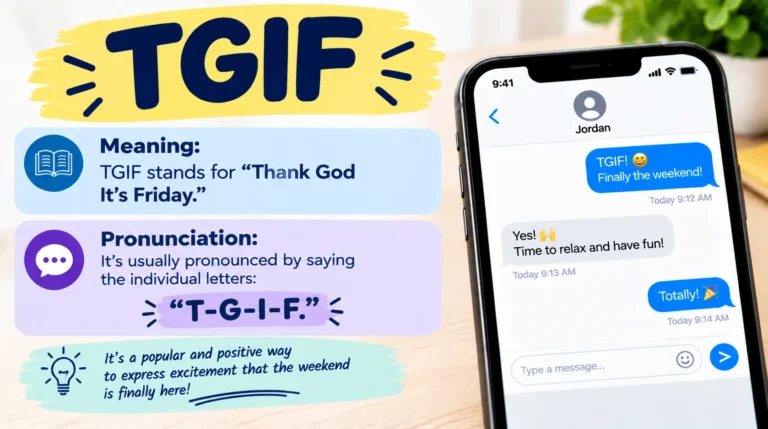
If someone sends you “TGIF” in a text, they are usually expressing happiness or relief that Friday has finally arrived.
The abbreviation is widely used in casual conversations, social media posts, group chats, and messages between friends and coworkers.
The full meaning is “Thank God It’s Friday” or, in some contexts, “Thank Goodness It’s Friday.”
It often communicates excitement about the weekend, relief after a long week, or anticipation of plans ahead.
If you searched “what does tgif mean in text,” the short answer is simple: it means the sender is happy that the workweek or school week is ending.
However, the exact tone can range from genuinely excited to funny, tired, sarcastic, or even slightly dramatic depending on the conversation.
Quick Answer
TGIF means “Thank God It’s Friday.” In texting, it is a casual expression of happiness or relief that Friday has arrived and the weekend is near. People often use TGIF when they are excited about weekend plans, tired after a long week, or simply glad that work or school is almost over.
What Does TGIF Mean in Text?
TGIF stands for “Thank God It’s Friday.”
It is an informal expression people use to celebrate the arrival of Friday. The phrase suggests that the sender has been waiting for the week to end and is happy that the weekend is beginning.
It is usually pronounced by saying each letter individually: “T-G-I-F.” However, in conversation, some people may simply say the full phrase instead.
The emotional tone is generally positive. Depending on the context, TGIF can express:
- Excitement about the weekend
- Relief after a busy week
- Tiredness from work or school
- Happiness about upcoming plans
- Humorous frustration about surviving a difficult week
Example:
Alex: This week felt like it lasted forever.
Jamie: Seriously. TGIF! 😩🎉
Here, TGIF means Jamie is relieved and happy that Friday has arrived.
Origin and Background of TGIF
TGIF began as a shortened form of the familiar English expression “Thank God It’s Friday.” The phrase reflects the long-standing idea that Friday marks the end of the traditional work or school week and the beginning of the weekend.
As informal communication became shorter through texting, online chat, and social media, the phrase was naturally reduced to its initials: TGIF.
Today, people use it in messages, captions, memes, workplace chats, and casual conversations. Its basic meaning has remained largely consistent: Friday has arrived, and that is usually considered something worth celebrating.
How TGIF Is Used in Text Conversations
TGIF is flexible and can fit several types of casual conversations.
Friendly and Casual Use
Friends often send TGIF when talking about weekend plans or simply sharing their excitement.
Sam: Any plans for tonight?
Taylor: Dinner with friends. TGIF! 🎉
The abbreviation adds enthusiasm and signals that the speaker is ready to enjoy the weekend.
Relief After a Busy Week
TGIF can express genuine exhaustion or relief.
Chris: I had three exams and two assignments this week.
Morgan: Wow, you survived. TGIF!
Here, the phrase means something like, “Thankfully, the difficult week is almost over.”
Humorous Use
People sometimes use TGIF dramatically for comic effect.
Me after answering 47 emails: TGIF 😭
The person is joking about being exhausted and ready for the weekend.
Sarcastic Use
TGIF can occasionally be sarcastic, especially when Friday is not going well.
My computer crashed five minutes before I finished work. TGIF, I guess. 🙃
The phrase normally expresses happiness, but “I guess,” a sarcastic emoji, or negative context can reverse the tone.
Romantic or Social Use
TGIF itself is not inherently romantic, but it may appear in messages involving plans with someone the sender likes.
You: So, are we still meeting tonight?
Them: Absolutely. TGIF 😊
In this situation, the positive feeling may relate both to Friday and to the upcoming date.
What TGIF Means on Different Platforms
TGIF generally keeps the same meaning across platforms. The surrounding content may change its tone, but the abbreviation itself usually means that the person is happy or relieved that Friday has arrived.
On WhatsApp, TGIF commonly appears in personal chats, family groups, and workplace conversations.
“Long week. TGIF!”
Snapchat
On Snapchat, it may appear with photos, filters, or weekend plans.
“TGIF 🎉 Who’s out tonight?”
Instagram users often use TGIF in captions or Stories to celebrate Friday, a night out, travel plans, or the start of the weekend.
TikTok
On TikTok, TGIF may appear in captions, comments, or videos about Friday routines, work exhaustion, weekend activities, or relatable humor.
Facebook users may use it in status updates to express excitement about the weekend.
Discord
In Discord communities, TGIF can appear in casual chat when members discuss gaming, events, or weekend plans.
Dating Apps
On dating apps, TGIF usually has the same meaning, but the context may make it more social or flirty.
“TGIF! Doing anything fun tonight?”
The abbreviation itself is not a flirtatious signal. The surrounding conversation determines whether the message has romantic interest.
What Does TGIF Mean From a Girl or Guy?
TGIF means essentially the same thing regardless of whether it comes from a girl, guy, or anyone else.
The important clues are the relationship between the people, the conversation topic, punctuation, emojis, and what happens next.
For example:
“TGIF!! 🎉”
This usually sounds enthusiastic and cheerful.
“TGIF… finally 😩”
This suggests exhaustion or relief.
“TGIF 😊 Can’t wait to see you tonight.”
Here, the abbreviation still means Friday has arrived, but the rest of the message creates a warmer or potentially romantic tone.
Avoid assuming that TGIF alone signals flirting or special interest. Look at the entire conversation instead.
Other Possible Meanings of TGIF
In everyday texting, “Thank God It’s Friday” is overwhelmingly the most common meaning. However, the phrase may occasionally be adapted depending on personal preference or context.
| Meaning | Context | Example |
|---|---|---|
| Thank God It’s Friday | Standard and most common texting meaning | “TGIF! I’m done with work.” |
| Thank Goodness It’s Friday | Used by people who prefer not to use “God” in the expression | “TGIF—this week was exhausting.” |
| A humorous variation | A joke based on the familiar initials | “TGIF: Thank Goodness I Finished!” |
Humorous expansions are not the standard definition. When someone sends TGIF without additional context, it almost always refers to Friday.
How to Respond to TGIF
Your reply can match the sender’s mood and the conversation.
Casual Reply
“Seriously! This week felt so long.”
Excited Reply
“TGIF indeed! 🎉 What are your weekend plans?”
Funny Reply
“We made it. Barely. 😂”
Friendly Reply
“Finally! Hope you have a great weekend.”
If You Have Plans Together
“TGIF! I’m looking forward to tonight 😊”
If You Feel Tired Too
“Same. I’m ready to do absolutely nothing this weekend.”
If You Want to Continue the Conversation
“TGIF! Got anything exciting planned?”
If You Are Confused About the Abbreviation
“TGIF means Thank God It’s Friday, right?”
Most responses can simply acknowledge the shared excitement or relief.
Similar Texting Terms and Differences
| Term | Meaning | Key Difference |
|---|---|---|
| TGIF | Thank God It’s Friday | Specifically celebrates Friday |
| FRI-YAY | A playful celebration of Friday | More humorous and energetic |
| Finally! | Relief that something has arrived or ended | Can apply to anything, not just Friday |
| Weekend mode | Ready to relax or enjoy the weekend | Focuses on the weekend rather than Friday itself |
| Yay! | General excitement | Does not specifically refer to Friday |
TGIF is more specific than these expressions because its meaning is directly connected to the arrival of Friday.
Common Misunderstandings About TGIF
One common misunderstanding is assuming that TGIF always means the sender is partying or going out. That is not necessarily true. Someone can say TGIF simply because they are relieved that work or school is ending.
Another mistake is interpreting TGIF as automatically religious. Although the traditional expansion includes “God,” many people use the abbreviation as a familiar expression without intending to make a religious statement. Some also interpret it as “Thank Goodness It’s Friday.”
Capitalization usually does not change the meaning:
- TGIF
- tgif
- Tgif
All generally mean the same thing in informal communication.
Tone can also be misunderstood. “TGIF!” usually sounds enthusiastic, while “TGIF, I guess 🙃” may be sarcastic or frustrated.
Is TGIF Appropriate or Safe to Use?
TGIF is generally safe, friendly, and non-offensive in casual communication. It does not normally suggest self-harm, abuse, threats, sexual content, or another serious concern.
It is most appropriate for:
- Friends
- Family chats
- Social media
- Casual workplace conversations
- School group chats
In very formal professional communication, spelling out your message or using a more neutral expression may be better.
For example, instead of writing:
“TGIF! Glad the project is done.”
in a formal business message, you might write:
“I’m glad we completed the project before the weekend.”
The abbreviation is informal, but it is not generally rude.
Examples of TGIF in Text
- TGIF! I honestly thought Friday would never arrive.
- Finished my last assignment for the week. TGIF 😭
- TGIF 🎉 Who wants to grab dinner tonight?
- This week was chaos, but we survived. TGIF!
- TGIF… I’m sleeping until noon tomorrow.
- Only two more hours of work. TGIF!
- You: How was your week?
Them: Exhausting. TGIF 😂 - TGIF! Road trip starts in three hours. 🚗
- My Friday meeting got canceled. TGIF just got better.
- TGIF, I guess 🙃 My weekend is already full of chores.
- No alarms tomorrow morning. TGIF!
- TGIF 😊 See you tonight!
Frequently Asked Questions
What does TGIF stand for in a text?
TGIF most commonly stands for “Thank God It’s Friday.” People use it to show happiness, excitement, or relief that Friday has arrived and the weekend is near. Depending on personal preference, some people may interpret it as “Thank Goodness It’s Friday.”
Is TGIF a positive expression?
Usually, yes. TGIF normally has a positive or relieved tone because it celebrates the end of a busy week. However, it can sometimes be sarcastic when the sender adds negative wording, unusual punctuation, or an emoji that suggests frustration.
Does TGIF mean someone is flirting?
No. TGIF by itself is not a flirting abbreviation. It simply refers to Friday. However, if someone combines it with affectionate language, emojis, or plans to meet you, the overall conversation may have a romantic or flirtatious tone.
Can I use TGIF at work?
You can usually use TGIF in casual workplace chats, especially with colleagues you know well. However, it may sound too informal for a formal email, professional report, or communication with someone who expects a more businesslike tone.
What is the difference between TGIF and Fri-Yay?
Both expressions celebrate Friday. TGIF means “Thank God It’s Friday” and often expresses relief or excitement. Fri-Yay is a playful word combining “Friday” and “yay,” usually emphasizing fun, energy, and enthusiasm.
Is TGIF still used in texting?
Yes. TGIF remains easy to understand and is still used in text messages, social media captions, memes, group chats, and casual online conversations. Its meaning is familiar to many English speakers, although people may also express the same feeling with phrases such as “Finally Friday” or “Weekend mode.”
Conclusion
TGIF most commonly means “Thank God It’s Friday” and expresses excitement, relief, or happiness that the week is ending.
It is a casual, friendly abbreviation that works naturally in texts, social media posts, and informal conversations.
The meaning usually stays the same across platforms and does not depend on whether it comes from a girl or guy.
To understand its exact tone, look at the surrounding message, emojis, and punctuation.
A simple response such as “Finally!” or “TGIF! What are your weekend plans?” usually fits perfectly.

I am Ava Richardson, a passionate language writer who loves making English words and their meanings simple and easy to understand.
I create clear definitions, useful examples, and practical explanations to help readers improve their English vocabulary.