
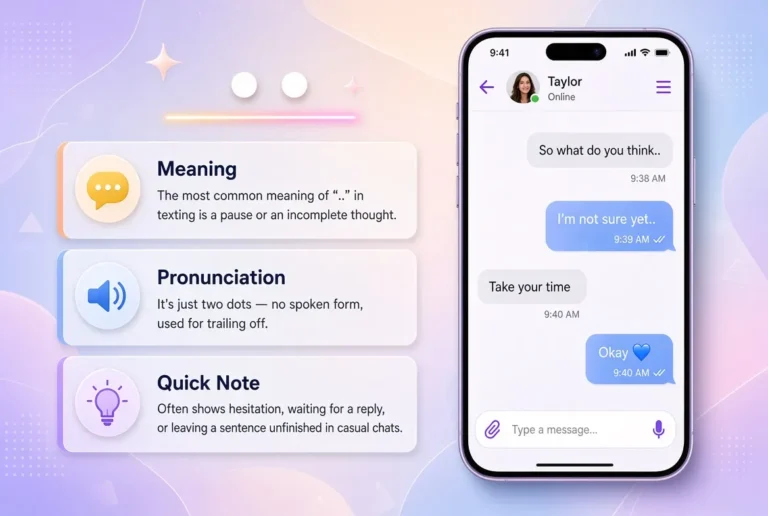
If you are wondering what does .. mean in text, the answer usually depends on the conversation and the tone of the message.
Two dots (“..”) are commonly used as an informal way to show a pause, hesitation, unfinished thought, or trailing emotion.
They are similar to an ellipsis (“…”), although three dots are the more standard form.
Someone might write “Okay..” because they are thinking, unsure, disappointed, annoyed, or simply pausing before continuing.
The two dots do not have one fixed dictionary definition, so context matters more than the punctuation itself.
To understand what “..” means in a particular message, look at the words before and after it, the relationship between the people talking, and any emojis or previous messages.
The same two dots can sound friendly in one conversation and slightly awkward or serious in another.
Quick Answer
“..” in text usually represents a pause, hesitation, unfinished thought, or trailing emotion. It is often an informal alternative to the standard three-dot ellipsis (“…”). Depending on context, “..” can make a message sound thoughtful, uncertain, disappointed, awkward, playful, or slightly passive-aggressive.
What Does “..” Mean in Text?
The most common meaning of “..” in texting is a pause or an incomplete thought.
Unlike abbreviations such as “LOL” or “BRB,” the two dots do not have a full form. They are punctuation used to affect the tone of a message.
A person may use “..” when they do not want their sentence to sound completely direct or final. It can suggest that there is more to say, even if they never actually continue the thought.
For example:
Person 1: “Did you like what I said?”
Person 2: “Yeah..”
The response “Yeah..” may simply mean “yes,” but the dots can make the answer sound hesitant or as though the person has additional thoughts.
Tone and Emotional Meaning
Depending on context, “..” can communicate:
- Hesitation
- Thinking or pausing
- Uncertainty
- Disappointment
- Awkwardness
- Mild annoyance
- Sadness
- Playfulness
- A thought that trails off
The punctuation itself does not automatically make a message negative. The surrounding conversation determines the emotional meaning.
Origin and Background of “..”
Two dots in texting are best understood as an informal variation of the ellipsis, which is traditionally written with three dots: “…”.
An ellipsis has long been used in writing to show omitted words, pauses, or thoughts that trail off. In casual online communication, people do not always follow formal punctuation rules.
As a result, some people type two dots instead of three, while others use four or more dots for emphasis.
There is no single confirmed origin for using exactly two dots in text messages.
It appears to have developed naturally through informal digital communication and personal typing habits.
How “..” Is Used in Text Conversations
Showing Hesitation
A person may use two dots when they are unsure how to respond.
Alex: “Are you coming tonight?”
Sam: “I think so..”
The dots can make the answer sound less certain than “I think so.”
Letting a Thought Trail Off
Sometimes “..” suggests that the person is leaving something unsaid.
“I thought things would be different..”
This can sound emotional or reflective.
Creating an Awkward Pause
Two dots can make a short response feel slightly awkward.
“Oh.. okay.”
The meaning may be completely harmless, but it can suggest surprise or uncertainty.
Showing Mild Disappointment
In some conversations, “..” can soften a disappointed reaction.
“You forgot again..”
This may sound more emotionally loaded than “You forgot again.”
Being Casual or Habitual
Some people simply type two dots regularly without attaching a special meaning to them.
“See you later..”
In this case, the dots may just be the sender’s personal texting style.
Playful or Flirty Use
In a romantic or playful conversation, dots can create anticipation.
“Maybe I have something to tell you.. 😏”
Here, the punctuation helps make the message feel teasing or mysterious.
What “..” Means on Different Platforms
The basic meaning of “..” usually remains similar across social media and messaging platforms. However, the style of conversation can influence how it feels.
On WhatsApp, “..” often represents a pause or trailing thought. In private conversations, it may also reflect the sender’s usual typing habits.
Snapchat
Because Snapchat conversations are often casual and fast-moving, two dots may be used for hesitation, awkward reactions, or playful teasing.
For example:
“You really said that.. 😭”
The dots can make the reaction feel more dramatic or conversational.
In Instagram direct messages and comments, “..” may add emotion to a short reaction or make a sentence feel unfinished.
“That photo is actually so good..”
TikTok
On TikTok, two dots may appear in comments or messages to create a pause before a reaction.
“Wait.. what happened here?”
The tone is often humorous, surprised, or dramatic.
On Facebook, some users use two dots simply as informal punctuation. In longer conversations, the intended meaning should be judged from the sentence rather than the number of dots.
Discord
On Discord, “..” may indicate hesitation, confusion, or an unfinished thought, especially in casual chats.
“I mean.. technically you’re right.”
Dating Apps
On dating apps, punctuation can sometimes affect how a message feels more strongly because people are still learning each other’s communication styles.
For example:
“Maybe we should meet sometime..”
The dots may make the message sound shy, tentative, or slightly flirtatious.
What Does “..” Mean From a Girl or Guy?
The meaning of “..” does not automatically change based on whether the sender is a girl or a guy. It is more useful to consider the person’s communication style and the relationship between you.
Someone who regularly uses “..” in every message may simply prefer that punctuation style. Someone who normally writes short, direct messages but suddenly sends “Okay..” may be expressing hesitation or another emotion.
Pay attention to clues such as:
- Previous messages
- Relationship between the two people
- Emojis
- The topic being discussed
- Changes in their usual writing style
- Whether the message continues after the dots
For example:
“I miss you.. ❤️”
The dots may make the message feel soft or emotionally hesitant.
But:
“Fine..”
The same punctuation could suggest annoyance, disappointment, or reluctance.
Context matters far more than gender.
Other Possible Meanings of “..”
The following meanings are possible, although a pause, hesitation, or trailing thought is the most common meaning in texting.
| Meaning | Context | Example |
|---|---|---|
| Pause or hesitation | The sender is thinking or unsure | “I guess you’re right..” |
| Unfinished thought | The message trails off | “I just thought maybe..” |
| Mild disappointment | The sender feels let down | “You didn’t tell me..” |
| Awkward reaction | The sender does not know what to say | “Oh..” |
| Playful suspense | The sender is teasing | “You’ll find out soon.. 😏” |
| Personal typing style | The sender regularly uses two dots | “Good morning.. how are you?” |
The same two dots can have different meanings, so they should not be interpreted without considering the full conversation.
How to Respond to “..”
Your response should depend on the message and the tone you notice.
1. Casual Response
Them: “I might come later..”
You: “No problem, just let me know.”
2. Curious Response
Them: “I wanted to tell you something..”
You: “What is it? Now I’m curious 😂”
3. Supportive Response
Them: “Things have been difficult lately..”
You: “I’m sorry. Do you want to talk about it?”
4. Clarifying Response
Them: “Yeah..”
You: “You seem unsure. What are you thinking?”
5. Funny Response
Them: “Well..”
You: “Those dots look suspicious 👀😂”
6. Friendly Response
Them: “Maybe another day..”
You: “Of course! We can plan something whenever you’re free.”
7. Romantic or Flirty Response
Them: “Maybe I’ll tell you later.. 😏”
You: “Now you definitely have to tell me later 😄”
8. Serious Response
If the conversation feels emotionally important, avoid focusing too much on the punctuation.
Them: “I don’t know what to do anymore..”
You: “I’m here with you. Do you want to tell me what’s going on?”
Similar Texting Terms and Differences
| Term | Meaning | Key Difference |
|---|---|---|
| … | Ellipsis or trailing pause | Three dots are the standard ellipsis |
| . | Full stop | Usually makes a statement feel complete or final |
| hmm | Thinking or uncertainty | Uses a word-like sound rather than punctuation |
| um | Hesitation | More directly represents spoken hesitation |
| idk | “I don’t know” | Clearly states uncertainty instead of only suggesting it |
While “..” can suggest hesitation, it does not always mean the sender is uncertain. Some people use it automatically.
Common Misunderstandings About “..”
One common mistake is assuming that two dots always mean the sender is angry or passive-aggressive. That is not necessarily true.
For example, a person who writes:
“Goodnight.. ❤️”
is probably not expressing anger. The dots may simply be part of their writing style.
Another misunderstanding is treating “..” as a secret code or abbreviation. It usually is not. Unlike texting slang, two dots generally communicate tone rather than representing specific words.
Capitalization does not normally change the meaning:
- “okay..”
- “Okay..”
- “OKAY..”
However, the capitalized version may feel stronger or more emotional because of the capital letters rather than the dots themselves.
Also, do not assume that two dots always have the exact same meaning as three dots. While they often serve a similar purpose in casual messaging, the sender may simply have typed fewer dots.
Is “..” Appropriate or Safe to Use?
Using “..” is generally safe and appropriate in casual texting and social media conversations. It is not offensive or inherently rude.
However, punctuation can sometimes create an unintended tone. For example, “Okay..” may sound hesitant or annoyed to someone who does not know your texting style.
In professional communication, especially formal emails or workplace messages, standard punctuation is usually clearer. If you want to show a pause, consider whether an ellipsis is actually necessary.
The dots themselves are not concerning, but the content of the message always matters more than the punctuation. If someone writes something that suggests they are in danger, deeply distressed, being abused, or thinking about harming themselves, take the words seriously rather than trying to interpret the dots.
Examples of “..” in Text
- “Oh.. I didn’t know that.”
- “I was going to call you, but then.. never mind.”
- “Maybe you’re right.. I need to think about it.”
- “You actually remembered.. 🥹”
- “Okay.. that was unexpected.”
- “I don’t know.. something feels different.”
- “Wait.. are you serious?”
- “I thought we were meeting today..”
- “Well.. this is awkward 😂”
- “I’ll tell you when I see you.. 😏”
- “Sure.. if that’s what you want.”
- “I miss those days..”
These examples show why the surrounding words are essential. The same punctuation can express surprise, uncertainty, sadness, teasing, or simple conversational rhythm.
Frequently Asked Questions
Is “..” the same as an ellipsis?
Not exactly. A standard ellipsis contains three dots (“…”). However, in casual texting, many people use two dots in a similar way to show a pause, hesitation, or thought that trails off. The meaning may be similar even though the punctuation is nonstandard.
Does “..” mean someone is mad at me?
Not necessarily. Two dots alone are not a reliable sign of anger. “Okay..” might sound hesitant or annoyed, but the sender may also simply use two dots as part of their normal texting style. Look at the entire conversation before drawing conclusions.
What does “okay..” mean in a text?
“Okay..” usually means “okay” with an added pause or emotional tone. Depending on context, it can sound uncertain, disappointed, awkward, reluctant, or thoughtful. If the sender normally uses two dots, however, it may have no special meaning at all.
Why do people use two dots instead of three?
The reason varies. Some people type quickly, some prefer the visual appearance of two dots, and others have developed the habit naturally. There is no universal rule or hidden meaning behind choosing two dots instead of the standard three-dot ellipsis.
Is “..” passive-aggressive?
It can sometimes make a message sound passive-aggressive, particularly after a short response such as “Fine..” or “Sure..”. However, the dots are not automatically passive-aggressive. The relationship, topic, wording, and sender’s normal communication style determine how the message should be understood.
What should I reply when someone sends “..”?
Usually, respond to the words rather than the punctuation. If the message seems incomplete or emotionally uncertain, you can ask a gentle follow-up question. For example, if someone writes “I don’t know..,” you might reply, “What are you thinking about?”
Conclusion
In texting, “..” usually represents a pause, hesitation, trailing thought, or emotional tone.
It is commonly used as an informal alternative to the standard three-dot ellipsis, although its meaning is highly dependent on context.
Two dots can make a message feel thoughtful, awkward, disappointed, uncertain, playful, or simply casual.
The best way to understand them is to look at the entire conversation and the sender’s usual writing style.
When replying, focus on what the person actually says and ask for clarification if their tone seems unclear.

I am Ava Richardson, a passionate language writer who loves making English words and their meanings simple and easy to understand.
I create clear definitions, useful examples, and practical explanations to help readers improve their English vocabulary.