
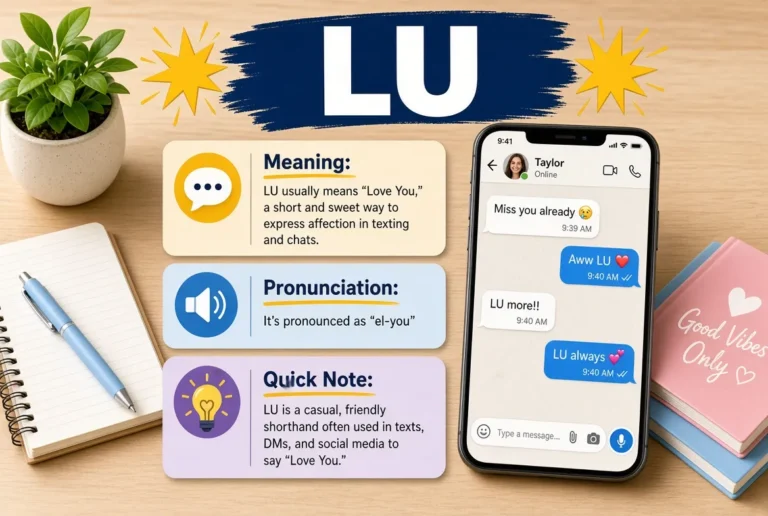
If someone has sent you “LU” and you are wondering what it means, the answer usually depends on the surrounding conversation.
In texting, LU most commonly means “Love You”, especially when used between friends, family members, or romantic partners.
However, short abbreviations can be highly context-dependent. “LU” may feel warm and affectionate in one conversation but simply be part of a name, phrase, or unrelated abbreviation in another.
The relationship between the sender and receiver, previous messages, punctuation, and emojis can all help clarify the intended meaning.
This guide explains what does lu mean in text, how people use it on different platforms, what it can mean from a girl or guy, possible alternative meanings, and how to respond naturally.
Quick Answer
LU usually means “Love You” in text messages. It is an informal abbreviation used to express affection, appreciation, or emotional closeness. Friends, family members, and romantic partners may all use “LU,” so the relationship and conversation context help determine whether the message is friendly or romantic.
What Does LU Mean in Text?
In most texting conversations, LU means “Love You.”
It is a shortened way of expressing affection without typing the full phrase. Some people write it casually as “lu,” while others use “LU” in capital letters.
Simple definition
LU = Love You
How is it pronounced?
People usually read “LU” as the phrase “love you,” rather than saying the individual letters aloud.
Tone and emotional meaning
The tone of “LU” is usually:
- Affectionate
- Warm
- Friendly
- Appreciative
- Romantic, depending on the relationship
For example:
Alex: Thanks for always being there for me.
Sam: Anytime, lu ❤️
In this conversation, “LU” clearly expresses affection. The heart emoji makes the emotional tone even stronger.
Origin and Background of LU
“LU” appears to have developed naturally from the common habit of shortening frequently used phrases in text messaging and online communication.
Early texting encouraged people to use fewer characters, and abbreviations became a convenient way to communicate quickly.
There is no single confirmed origin or specific date when “LU” first entered common online use. It is best understood as a simple shortening of the words “Love You.”
Similar expressions such as “ILY” for “I love you” and “LY” for “love you” follow the same pattern of reducing commonly typed phrases.
How LU Is Used in Text Conversations
The meaning of “LU” is usually easy to understand when you look at the conversation around it.
Friendly use
Friends may use “LU” to show appreciation without intending romance.
Friend 1: Thanks for helping me with my assignment.
Friend 2: Of course, lu!
Here, the abbreviation likely means affection between friends.
Romantic use
Between people in a romantic relationship or flirtatious conversation, “LU” may carry a more romantic meaning.
Taylor: I can’t stop thinking about you.
Jordan: Aww, lu ❤️
The emotional context suggests that “love you” may be romantic.
Family use
Family members may also use it casually.
Mum: Have a great day at school!
Child: Thanks, lu!
The meaning is affectionate but not romantic.
Appreciative use
Sometimes “LU” appears at the end of a message after someone receives help or support.
Chris: Thanks for listening to me tonight.
Jamie: Always here for you. LU.
This can express emotional closeness and gratitude.
Humorous or casual use
Some people use affectionate abbreviations playfully.
Friend: You brought me coffee?
You: Obviously. LU 😂
The laughing emoji suggests a lighthearted, joking tone.
Can LU be sarcastic?
It can be sarcastic in unusual situations, but sarcasm is not its normal meaning.
For example:
Friend: I just ate the last slice of your pizza.
You: LU sooo much 🙄
The words around “LU” and the eye-roll emoji change the tone.
What LU Means on Different Platforms
The basic meaning of “LU” generally remains “Love You” across major messaging and social platforms.
On WhatsApp, LU is commonly used in private chats with friends, family, or partners. Conversation history usually makes the emotional meaning clear.
Snapchat
On Snapchat, “lu” may appear in quick chats, captions, or replies. Because Snapchat conversations can be casual and fast-paced, it may be used more casually than a full “I love you.”
People may use LU in direct messages, comments, or replies to friends. Emojis and the relationship between users can help show whether the tone is friendly or romantic.
TikTok
On TikTok, LU may appear in comments or messages as a quick expression of affection or appreciation. The surrounding content is important.
Facebook users may use “LU” in Messenger conversations or comments, especially between people who already know each other well.
Discord
On Discord, the meaning depends heavily on the community and relationship between users. Friends may use LU casually or jokingly, while romantic conversations may give it a more intimate meaning.
Dating apps
On dating apps, “LU” can potentially sound more personal or romantic. However, context matters. Someone using it early in a conversation may simply be playful, while repeated affectionate messages may suggest stronger interest.
What Does LU Mean From a Girl or Guy?
“LU” does not automatically mean something different depending on whether it comes from a girl or a guy.
The sender’s gender is usually much less important than your relationship and the conversation itself.
Look for clues such as:
- What was discussed immediately before the message?
- Are you close friends, family members, or dating?
- Does the sender regularly use affectionate language?
- Are romantic emojis included?
- Is the message playful or serious?
- Has the person expressed romantic interest before?
For example:
“Thanks for today, lu 😊” may simply be friendly.
“Goodnight, LU ❤️🥰” may feel more emotionally or romantically intimate.
Punctuation and emojis can change the interpretation. “lu lol” may sound casual, while “LU ❤️” may feel more emotionally meaningful.
Other Possible Meanings of LU
Although “Love You” is the most common meaning of LU in personal texting, the abbreviation can have other meanings in specific contexts.
| Meaning | Context | Example |
|---|---|---|
| Love You | Personal texting and social messages | “Thanks for everything, LU ❤️” |
| Look Up | Instructions or casual directions | “LU the address before you leave.” |
| A person’s initials | Names or usernames | “LU joined the group chat.” |
| Context-specific abbreviation | Schools, games, organisations, or technical discussions | “Check what LU means in this document.” |
The first meaning—Love You—is generally the one people mean when “LU” appears as a short affectionate message.
How to Respond to LU
Your response should match the relationship and tone of the conversation.
If you feel the same
Them: LU ❤️
You: Love you too ❤️
This is the most natural response when you want to return the affection.
Friendly response
Them: Thanks for everything, LU!
You: Aww, anytime! 😊
This keeps the conversation warm without necessarily making it romantic.
Casual response
Them: LU
You: Lu too!
A short response works well when both people normally communicate casually.
Playful response
Them: LU 😂
You: I knew you couldn’t stay mad at me 😂
This is useful when the conversation is humorous.
If you are unsure what they mean
You can simply ask:
“Aww, do you mean love you? 😊”
This is especially useful if the abbreviation appears unexpectedly.
If you want to keep the response neutral
“That’s sweet, thank you 😊”
This can acknowledge the message without making the conversation more romantic.
If you do not feel comfortable returning it
You do not have to say “love you too.” You can respond honestly and politely:
“Aww, that’s kind of you.”
Your reply should reflect your actual comfort level and relationship with the sender.
Similar Texting Terms and Differences
| Term | Meaning | Key Difference |
|---|---|---|
| LU | Love You | A very short informal version |
| LY | Love You | Similar meaning; often used casually |
| ILY | I Love You | Includes the speaker’s “I,” making the statement more explicit |
| ILYSM | I Love You So Much | Expresses stronger affection |
| XOXO | Hugs and kisses | Expresses affection differently and may be friendly or romantic |
LU vs. ILY
“LU” means “Love You,” while “ILY” means “I Love You.”
The difference may seem small, but “ILY” can sometimes feel more like a complete emotional statement.
LU vs. ILYSM
“ILYSM” means “I Love You So Much,” which is generally more emphatic than LU.
LU vs. XOXO
“XOXO” represents affection through the idea of hugs and kisses. LU directly communicates the words “love you.”
Common Misunderstandings About LU
One common misunderstanding is assuming that “LU” is always romantic. It is not.
Friends and family members can use “LU” with no romantic intention. The relationship between the people involved is one of the most important clues.
Another possible misunderstanding is confusing “LU” with initials, usernames, or abbreviations used in a specific community. If the message says something like “LU is online,” it probably does not mean “love you.”
Capitalization usually does not change the meaning:
- lu
- LU
- Lu
In an affectionate text, all three may mean “love you.” However, “Lu” can also be a name or initials depending on the context.
Is LU Appropriate or Safe to Use?
LU is generally informal, polite, and harmless when used to mean “love you.”
It is appropriate in personal conversations with people who are comfortable with affectionate language. Friends, family members, and romantic partners may all use it naturally.
However, it is usually not appropriate for formal communication, professional emails, or workplace conversations unless you have a very close personal relationship with the recipient outside work.
Because “LU” can be interpreted as emotionally affectionate, consider your relationship before using it. If someone sends it and you are unsure about their intentions, look at the broader conversation rather than assuming it is romantic.
LU does not normally suggest self-harm, abuse, threats, or another serious safety concern.
Examples of LU in Text
Here are some realistic ways “LU” can appear in messages:
- Thanks for picking me up today, lu! 😊
- I’m home safely. LU, talk tomorrow ❤️
- You seriously made my whole day. LU!
- Goodnighttt, lu 😴❤️
- Aww, you’re the best. Lu!
- I can’t believe you remembered my birthday 😭 LU so much!
- Don’t worry about it, lu. I’ve got you.
- Okay, okay, I forgive you 😂 LU.
- Have a safe flight! LU ❤️
- Thanks for listening when I needed someone. LU.
- Miss hanging out with you already, lu 😭
- Mum says LU and wants you to call when you get home.
Frequently Asked Questions
Does LU mean “I love you”?
Usually, LU means “Love You,” rather than the full phrase “I love you.” In casual conversation, however, the emotional meaning can be very similar. The difference is that “ILY” explicitly includes the word “I,” while LU is a shorter expression directed toward the other person.
Is LU romantic?
It can be romantic, but it is not automatically romantic. Friends and family members also use LU to show affection. Check your relationship with the sender, the rest of the conversation, and any emojis or affectionate wording before deciding what they mean.
What does “lu” mean with a heart emoji?
When someone writes “lu ❤️,” it usually means “love you” with added emotional warmth. A heart emoji can make the message feel more affectionate, but whether it is romantic or friendly still depends on the relationship and conversation.
Can I use LU with my friends?
Yes. Many people use LU casually with close friends. However, not everyone communicates affection in the same way, so consider whether your friend normally uses phrases such as “love you” or similar expressions.
What is the difference between LU and LY?
Both can mean “Love You.” They are simply different shortened versions of the same phrase. Usage can vary between friend groups and online communities, and neither abbreviation has a universally stronger emotional meaning.
What should I reply when someone texts LU?
If you feel the same, you can reply with “Love you too,” “LU too,” or a heart emoji. If you are unsure about the meaning or do not want to return the same level of affection, a neutral response such as “Aww, that’s sweet 😊” can work well.
Conclusion
In text messages, LU most commonly means “Love You.” It is a short, informal expression of affection that can be used between friends, family members, and romantic partners.
The abbreviation itself does not automatically reveal whether the message is romantic, so context is essential.
Look at your relationship with the sender, the conversation before and after the message, and clues such as emojis or punctuation.
If you are comfortable returning the affection, a simple “Love you too” works naturally. If you are unsure, a friendly question or neutral reply can help.

I am Ava Richardson, a passionate language writer who loves making English words and their meanings simple and easy to understand.
I create clear definitions, useful examples, and practical explanations to help readers improve their English vocabulary.