
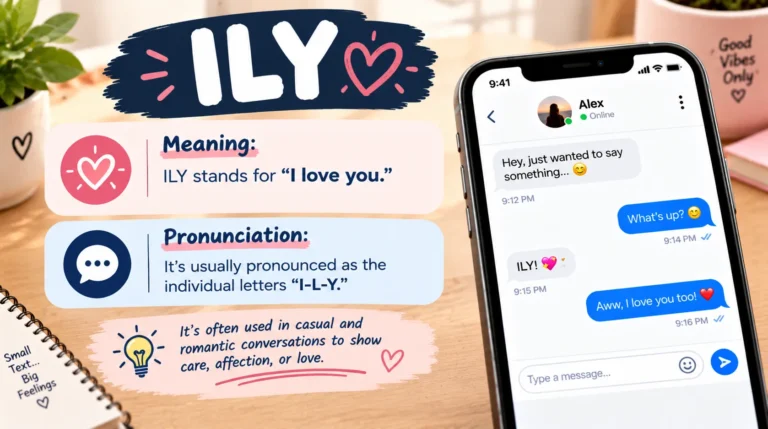
If you have received “ILY” in a message and are wondering what it means, the answer is usually simple but can feel emotionally important.
ILY is a common texting abbreviation used to express affection, appreciation, or love.
The meaning can depend on who sends it and the relationship you have with that person.
A romantic partner may use ILY to express deep love, while a close friend or family member may use it warmly and platonically.
Emojis, punctuation, timing, and the surrounding conversation can also help you understand the intended tone.
If you searched “what do ily mean in text,” the most common answer is that ILY means “I love you.”
Quick Answer
ILY means “I love you” in text messages and online conversations. People use it as a short, informal way to express love or strong affection. Depending on the relationship and context, ILY can be romantic, friendly, or family-related, so the sender and surrounding conversation matter.
What Does ILY Mean in Text?
ILY stands for “I love you.”
It is an abbreviation created by taking the first letter of each word:
- I = I
- L = Love
- Y = You
People generally pronounce it by saying the individual letters, “I-L-Y,” although they usually understand it simply as “I love you.”
The tone is usually warm, affectionate, and positive. However, the emotional intensity can vary. An ILY from a romantic partner may carry a different level of meaning than an ILY sent between close friends.
Example:
Alex: Thanks for always being there for me.
Sam: Of course. ILY ❤️
In this conversation, ILY expresses affection and appreciation.
Origin and Background of ILY
ILY developed naturally as part of shortened digital communication. Text messaging, instant messaging, chat rooms, and later social media encouraged people to shorten frequently used expressions.
“I love you” is a phrase people use often in personal conversations, so reducing it to ILY makes communication faster and more casual.
There is no need to attach ILY to one specific inventor or exact date. Like many texting abbreviations, it spread through everyday online communication rather than having one clearly documented origin.
Today, ILY is widely recognized in text messages, social media comments, private chats, and other informal digital conversations.
How ILY Is Used in Text Conversations
ILY can be used in several situations, and context determines whether the message sounds romantic, friendly, playful, or deeply emotional.
Romantic Use
In a romantic relationship, ILY usually means exactly what it says: the sender is expressing love.
Jamie: I can’t wait to see you tomorrow.
Taylor: Me too. ILY ❤️
The heart emoji makes the romantic or affectionate tone stronger.
Friendly Use
Close friends sometimes say ILY without romantic intentions.
Friend 1: You literally saved my day.
Friend 2: Haha anytime, ily!
Here, ILY means something closer to strong affection and appreciation between friends.
Family Use
Family members may also use ILY as a quick and affectionate sign-off.
Mom: Have a safe trip home.
Child: I will. ILY!
The meaning is loving and caring but not romantic.
Emotional or Supportive Use
ILY can become especially meaningful during an emotional conversation.
Person 1: Thanks for listening when I needed someone.
Person 2: Always. ILY.
In this context, the abbreviation can communicate emotional support and closeness.
Playful or Humorous Use
Friends may occasionally use ILY dramatically or jokingly.
Friend: You brought me coffee?
You: Obviously.
Friend: ILY SO MUCH 😂
The meaning is still positive, but the exaggerated wording makes the tone playful.
What ILY Means on Different Platforms
The basic meaning of ILY generally remains “I love you” across platforms. What changes is the style of communication and the relationship between users.
On WhatsApp, ILY commonly appears in private conversations between partners, friends, and family members. Context usually makes the intended meaning clear.
Snapchat
ILY on Snapchat may be used casually between close friends because the platform often encourages quick, informal communication. It can also be romantic in private chats.
People may use ILY in direct messages, comments, captions, or replies. For example, someone might comment “ILY 😭❤️” under a friend’s photo to show affection or enthusiasm.
TikTok
On TikTok, ILY may appear in comments and replies as an affectionate response to a creator, friend, or entertaining video. It does not always indicate personal or romantic love.
ILY is commonly used in Messenger conversations and occasionally in comments between friends and family members.
Discord
On Discord, the meaning depends heavily on the community and relationship between users. Friends may use ILY casually, while close relationships may give the phrase more emotional weight.
Dating Apps
On dating apps, ILY can carry greater significance because the conversation may already have romantic intentions. However, timing matters. If someone says ILY very early, it may be sincere, playful, exaggerated, or simply part of their communication style.
What Does ILY Mean From a Girl or Guy?
ILY does not automatically mean something different based on whether it comes from a girl or a guy. The sender’s gender alone is not enough to determine whether the message is romantic.
Instead, consider:
- Your relationship with the sender
- What you were discussing
- How often they express affection
- Whether romantic language is already present
- Emojis and punctuation
- Whether they say similar things to friends
- The timing of the message
For example:
ILY ❤️🥰 Can’t wait to see you tonight
This strongly suggests romantic affection if sent between people who are dating.
Meanwhile:
ILY BESTIE 😭😂
Usually suggests friendly affection rather than romance.
Context is more useful than making assumptions about the sender’s gender.
Other Possible Meanings of ILY
In normal texting, “I love you” is overwhelmingly the most common meaning of ILY. Genuine alternatives are uncommon and usually depend on specialized communities rather than ordinary conversation.
| Meaning | Context | Example |
|---|---|---|
| I love you | Standard texting, social media, friends, family, relationships | “Goodnight, ILY ❤️” |
| Strong affection or appreciation | Casual conversation between close friends | “You helped me so much today, ily!” |
| Playful exaggerated affection | Humorous or enthusiastic messages | “You got tickets for us? ILY 😂” |
The second and third meanings are really variations in tone and intention, not completely different definitions of the abbreviation.
How to Respond to ILY
Your response should depend on how you feel and the relationship you have with the sender.
If You Feel the Same
Them: ILY ❤️
You: ILY too ❤️
Simple and natural.
If You Want to Be Extra Affectionate
Them: ILY
You: I love you more 🥹❤️
This works well in close or romantic relationships.
If It Is From a Friend
Them: ILY bestie!
You: Aww ily too! You’re the best 😭❤️
This matches a warm, friendly tone.
If You Want to Be Funny
Them: ILY 😂
You: Finally, someone recognizes my greatness 😂
This keeps the conversation playful.
If You Feel Appreciative
Them: ILY
You: Aww, that’s so sweet. I appreciate you so much ❤️
This expresses warmth without necessarily repeating the exact phrase.
If You Are Unsure About Their Meaning
Them: ILY
You: Aww 😅 What made you say that?
This gives the sender an opportunity to explain their feelings naturally.
If You Do Not Feel Comfortable Saying It Back
You do not have to reply with ILY simply because someone sent it to you.
A respectful response could be:
That’s really sweet of you. I care about you too.
Similar Texting Terms and Differences
| Term | Meaning | Key Difference |
|---|---|---|
| ILY | I love you | Standard abbreviation for the full phrase |
| ILU | I love you | Same meaning; uses “U” instead of “Y” |
| LY | Love you | More casual and shorter |
| ILYSM | I love you so much | Expresses stronger affection |
| ILY2 | I love you too | A quick reply to someone who says ILY |
These abbreviations can all communicate affection, but the extra words often change the intensity.
For example, ILYSM usually sounds stronger or more enthusiastic than a simple ILY.
Common Misunderstandings About ILY
One common mistake is assuming that ILY is always romantic. Many close friends and family members use it without romantic intentions.
Another misunderstanding is thinking that capitalization changes the meaning.
- ILY
- ily
- Ily
All normally mean the same thing. Capitalization usually reflects typing style rather than emotional intensity.
However, the way the message is written can affect tone.
For example:
ily
May feel casual and relaxed.
ILY!!! ❤️❤️
May feel more excited, enthusiastic, or emotional.
Another clue is the conversation itself. If someone normally uses affectionate abbreviations with everyone, ILY may simply be part of their communication style.
Is ILY Appropriate or Safe to Use?
ILY is generally polite, affectionate, and safe to use in personal conversations. It is not inherently rude or offensive.
However, it is informal, so it may not be appropriate in professional communication unless you have a genuinely close personal relationship with the recipient.
Because “I love you” can carry emotional significance, it is also important not to pressure someone into saying it back. Different people have different comfort levels with affectionate language.
If someone sends ILY during a serious or emotional conversation, pay attention to the surrounding messages rather than focusing only on the abbreviation. In most cases, ILY is simply an expression of affection and care.
Examples of ILY in Text
- Thanks for coming with me today, ily ❤️
- ILY too! Sleep well and text me tomorrow.
- You remembered my favorite snack? ILY 😂
- Good luck with your exam tomorrow. ILY, you’ve got this!
- Aww, you’re honestly the sweetest. ILYSM 🥹
- Don’t worry, I’m not going anywhere. ILY.
- ILY bestie 😭 Thank you for listening to me complain for two hours.
- Mom: Drive safely.
Me: I will, ILY! - I know we’ve been busy lately, but ILY and I’m thinking about you.
- You made me laugh when I really needed it. ILY for that 😂
- ILY ❤️ Can’t wait until the weekend!
- Okay, okay, you were right. ILY… but don’t get used to hearing that 😂
Frequently Asked Questions
Does ILY always mean “I love you”?
Yes. In ordinary texting and social media conversations, ILY almost always stands for “I love you.” The main thing that changes is the type of love or affection being expressed. It may be romantic, friendly, family-related, playful, or emotionally supportive depending on the relationship.
Is ILY romantic?
ILY can be romantic, but it is not automatically romantic. Close friends and family members also use it regularly. Look at the relationship, previous conversations, emojis, and other affectionate language before deciding whether the sender intends romantic love.
What is the difference between ILY and ILU?
There is usually no difference in meaning. ILY means “I love you,” and ILU also means “I love you.” The difference is simply the abbreviation style: one uses the first letter of “you,” while the other uses the texting shortcut “U.”
What does “ily” mean with a heart emoji?
An abbreviation such as “ily ❤️” usually adds warmth and emotional emphasis. Depending on the relationship and type of heart used, it may sound romantic or simply affectionate. The emoji alone does not guarantee a romantic meaning.
What should I say back when someone texts ILY?
If you feel the same, you can simply say “ILY too.” If you care about the person but do not want to use the same words, you can say something like “Aww, I care about you too” or “That’s so sweet. I appreciate you.”
Is ILY appropriate for friends?
Yes. Many friends use ILY to express closeness, appreciation, and affection. Messages such as “ILY bestie!” or “Thanks for always being there, ily!” are usually friendly rather than romantic.
Conclusion
ILY is a widely used texting abbreviation that means “I love you.” Its basic definition stays the same, but the emotional meaning can range from romantic love to friendship, family affection, appreciation, or playful enthusiasm.
The best way to understand ILY is to consider who sent it, your relationship, the surrounding conversation, and any emojis or punctuation.
If you feel comfortable, respond naturally and honestly—whether that means saying “ILY too,” expressing appreciation, or simply acknowledging the sender’s affection warmly.

I am Ava Richardson, a passionate language writer who loves making English words and their meanings simple and easy to understand.
I create clear definitions, useful examples, and practical explanations to help readers improve their English vocabulary.