
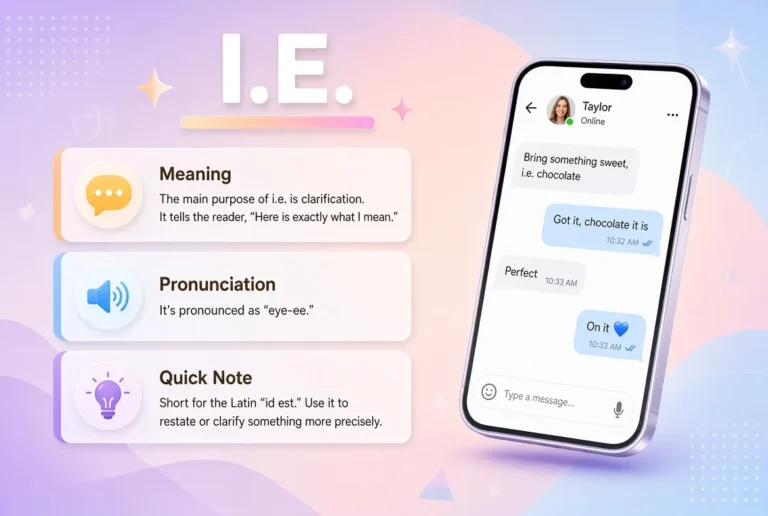
If you are wondering what does i.e. mean in text, the answer is simple: i.e. means “that is” or “in other words.” People use it when they want to clarify, explain, or restate something more precisely.
You may see i.e. in text messages, emails, social media posts, school discussions, and online conversations.
Although it can look formal compared with common texting abbreviations such as lol or idk, its meaning remains straightforward.
The main thing to remember is that i.e. introduces a clearer explanation of something already mentioned.
It does not usually add a random example. Understanding this difference can also help you avoid confusing i.e. with e.g., another abbreviation that appears frequently in writing and online communication.
Quick Answer
I.e. means “that is” or “in other words.” It is used to clarify or explain something more specifically. In text, someone may write “I’m free on weekends, i.e., Saturday and Sunday,” meaning Saturday and Sunday are exactly what they mean by weekends.
What Does I.E. Mean in Text?
I.e. is an abbreviation for the Latin phrase id est, which translates to “that is.” In modern English, it is commonly understood as “in other words” or “more specifically.”
People use it when they want to restate something and make their intended meaning clearer.
It is commonly pronounced by saying the individual letters: “eye-ee.” People do not usually pronounce the Latin phrase during an ordinary conversation.
The tone of i.e. is generally neutral and explanatory. It does not automatically sound friendly, romantic, sarcastic, rude, or emotional. However, the overall sentence can have any of those tones depending on the conversation.
Text example:
“I only eat one type of seafood, i.e., shrimp.”
This means shrimp is the specific type of seafood the person is referring to.
Origin and Background of I.E.
The abbreviation i.e. comes from the Latin phrase id est, meaning “that is.” It has been used in formal and academic writing for a long time and later became common in everyday digital communication.
Unlike slang abbreviations that developed specifically through texting or social media, i.e. did not originate as internet slang. Instead, people brought an existing writing abbreviation into emails, messages, online posts, and chats.
Today, you may see it in professional communication, school discussions, captions, comments, and casual conversations. Some people prefer writing “in other words” because it can sound more natural and immediately understandable.
How I.E. Is Used in Text Conversations
The main purpose of i.e. is clarification. It tells the reader, “Here is exactly what I mean.”
Clarifying a General Statement
Person A: “I don’t like crowded places.”
Person B: “i.e., concerts and busy malls?”
Person A: “Exactly.”
Here, the second person is checking whether those places are what the first person specifically means.
Giving a More Specific Meaning
“I need a break from work, i.e., I need a few days with no meetings or emails.”
The second part explains exactly what the speaker means by needing a break.
Correcting or Refining a Statement
“We should meet later, i.e., after 7 p.m. when I’m finished.”
The writer is narrowing the meaning of “later” to a specific time.
Casual Conversation
Friend: “I’m avoiding distractions today.”
You: “i.e., no TikTok?”
Friend: “Yes, and no games either 😂”
This use can sound casual and humorous because of the surrounding conversation.
Sarcastic or Playful Use
Person A: “I’m going to have a quiet weekend.”
Person B: “i.e., staying home and watching five seasons of a show? 😂”
Here, i.e. is still being used to clarify, but the overall tone is playful.
What I.E. Means on Different Platforms
The meaning of i.e. generally does not change from one platform to another. The platform mainly affects how formal or casual the abbreviation appears.
On WhatsApp, i.e. may appear when someone wants to clarify a plan, instruction, or statement.
“Bring casual clothes, i.e., jeans and a T-shirt.”
Snapchat
Because Snapchat conversations are often quick and informal, i.e. is less common than simple phrases such as “like” or “I mean.” However, its meaning remains the same.
“You know what I mean, i.e., that awkward situation yesterday 😭”
You may see i.e. in captions, comments, or informational posts when someone wants to explain something precisely.
“My favorite comfort food, i.e., anything involving pasta.”
TikTok
On TikTok, i.e. can appear in captions or comments, especially in educational, humorous, or explanatory content. Many users may instead write “meaning” or “in other words.”
Facebook users may use i.e. in longer posts, discussions, groups, or comments. It often appears in explanatory writing.
Discord
On Discord, i.e. can be useful in discussions about games, technology, school, or communities where someone needs to clarify a point.
“The event starts after reset, i.e., at midnight server time.”
Dating Apps
On dating apps, i.e. has no special romantic meaning. Someone might use it while clarifying their interests or intentions.
“I’m looking for something serious, i.e., an actual relationship rather than casual chatting.”
The surrounding statement—not the abbreviation itself—determines whether the message sounds romantic or serious.
What Does I.E. Mean From a Girl or Guy?
I.e. means the same thing regardless of whether it is sent by a girl, guy, friend, colleague, or romantic interest. It usually means “that is” or “in other words.”
Gender does not change the definition.
What can change the interpretation is the relationship between the people, the surrounding conversation, punctuation, emojis, and tone.
For example:
“I like a certain type of person, i.e., someone funny 😉”
The abbreviation itself is neutral, but the wink emoji and conversation context could make the message sound flirtatious.
Similarly:
“I need space, i.e., please don’t message me tonight.”
This sounds serious because of the words surrounding i.e., not because the abbreviation has a negative meaning.
When interpreting a message, look at what comes before and after i.e.. The phrase following it usually explains the sender’s exact meaning.
Other Possible Meanings of I.E.
In ordinary English texting and writing, “that is” or “in other words” is by far the most common meaning of i.e.
The abbreviation can technically have different meanings in specialized fields, organizations, or names, but those meanings depend heavily on context and are not standard texting meanings.
| Meaning | Context | Example |
|---|---|---|
| That is / in other words | Standard English writing and texting; the most common meaning | “I prefer warm drinks, i.e., tea and coffee.” |
| A context-specific abbreviation | Technical, professional, organizational, or subject-specific discussions | “Check the IE settings first.” |
The second meaning is not a universal texting definition. If IE appears without periods and seems connected to technology, work, a name, or a specific subject, the conversation context may indicate a different meaning.
How to Respond to I.E.
You usually do not need a special response to i.e.. Simply respond to the clarification or information that follows it.
Casual
Them: “I’m busy this afternoon, i.e., until 5.”
You: “No problem, I’ll message you after 5.”
Friendly
Them: “I want comfort food tonight, i.e., pizza 😂”
You: “Honestly, that’s a perfect choice 😂”
Funny
Them: “I’m exercising today, i.e., walking to the fridge.”
You: “That sounds like an intense workout 😭”
Clarifying
Them: “I need a quieter place, i.e., somewhere without music.”
You: “Got it. So somewhere calm and quiet?”
Confused
If you are unfamiliar with the abbreviation, you can simply ask:
“Do you mean ‘in other words’?”
Agreeing
“Yes, exactly. That’s what I meant too.”
Romantic
Them: “My ideal date is simple, i.e., good food and good company 😊”
You: “I think I could help with the good company part 😊”
Serious
Them: “I need some time alone, i.e., I won’t be replying much.”
You: “I understand. Take the time you need.”
Similar Texting Terms and Differences
| Term | Meaning | Key Difference |
|---|---|---|
| i.e. | That is; in other words | Clarifies or restates something specifically |
| e.g. | For example | Gives one or more examples rather than an exact restatement |
| AKA | Also known as | Introduces another name or identity |
| IMO | In my opinion | Shows that a statement is a personal opinion |
| FYI | For your information | Shares information rather than clarifying a previous statement |
The most commonly confused pair is i.e. and e.g.
Consider the difference:
“I like one sport, i.e., tennis.”
This means tennis is the specific sport being referred to.
“I like sports, e.g., tennis and basketball.”
This gives tennis and basketball as examples of sports.
Common Misunderstandings
One of the biggest misunderstandings is assuming i.e. means “for example.” It usually does not.
Confusing I.E. With E.G.
Use i.e. when you mean “that is” or “in other words.”
Use e.g. when you mean “for example.”
Thinking It Is Texting Slang
Although it is commonly used online, i.e. is not traditional internet slang. It is a long-established abbreviation used in English writing.
Capitalization Differences
You may see:
- i.e.
- I.E.
- ie
- IE
The standard form is i.e., usually written in lowercase with periods. However, informal messages often leave out punctuation.
Without periods, IE can sometimes have a completely different meaning depending on context.
Overusing It
In casual texting, repeatedly using i.e. may sound more formal than necessary. Sometimes writing “I mean” or “in other words” feels more natural.
Is I.E. Appropriate or Safe to Use?
Yes. I.e. is generally polite, neutral, and safe to use. It does not contain profanity, insults, sexual meaning, threats, or harmful language.
It can be appropriate in:
- Text messages
- Emails
- School assignments
- Online discussions
- Workplace communication
- Social media posts
However, some readers may not immediately understand it, especially in very casual conversations. In those situations, writing “in other words” or “that is” may be clearer.
In professional writing, correct punctuation and clarity matter. If you think the abbreviation could confuse the reader, using the full English phrase is often the better choice.
Examples of I.E. in Text
- “I’m only free one day this week, i.e., Friday.”
- “I want something light for dinner, i.e., not pizza again 😂”
- “The meeting is online, i.e., you don’t need to come to the office.”
- “She’s my oldest cousin, i.e., the one I told you about last week.”
- “I need a proper break, i.e., no work messages for at least two days.”
- “My favorite kind of weather is cool and cloudy, i.e., perfect hoodie weather.”
- “Bring your essentials, i.e., your phone, charger, and ID.”
- “I’m avoiding expensive plans tonight, i.e., I’m staying home 😭”
- “He wants a serious relationship, i.e., something long-term.”
- “The assignment has one main requirement, i.e., answer the question directly.”
- “I’m taking a social media break, i.e., deleting the apps for a while.”
- “We should choose somewhere close, i.e., within walking distance.”
Frequently Asked Questions
What does i.e. stand for?
I.e. stands for the Latin phrase “id est,” which means “that is.” In modern English, people commonly understand it as “in other words” or “more specifically.” It is used to clarify or precisely explain something mentioned earlier.
Does i.e. mean for example?
No. I.e. usually means “that is” or “in other words,” while e.g. means “for example.” Use i.e. when you are clarifying the exact meaning of something and e.g. when you are giving possible examples.
How do you pronounce i.e.?
In English conversation, i.e. is normally pronounced by saying “eye-ee.” People generally do not pronounce the original Latin phrase id est when reading an ordinary message or sentence aloud.
Is i.e. formal or informal?
I.e. can be used in both formal and informal writing, although it may look more formal than common texting language. It is especially common in academic, professional, and explanatory writing. In casual texts, “I mean” or “in other words” may sometimes sound more natural.
Does i.e. have a special meaning on Snapchat or Instagram?
No. I.e. normally keeps the same meaning across Snapchat, Instagram, WhatsApp, TikTok, and other platforms. It still means “that is” or “in other words.” The surrounding message determines whether the overall tone is casual, funny, serious, or romantic.
Should I use periods in i.e.?
The traditional and widely recognized spelling is i.e. with periods. In informal texting, some people write “ie” instead. However, removing the periods can occasionally create confusion because IE may have other meanings in technical or context-specific conversations.
Conclusion
I.e. means “that is” or “in other words,” and people use it to clarify exactly what they mean.
Its definition does not change based on whether it appears in a text message, WhatsApp chat, Instagram comment, Discord conversation, or message from a girl or guy.
The most important distinction is between i.e., which clarifies, and e.g., which gives examples.
When you receive i.e. in a message, read the words that follow it—they usually provide the sender’s more precise meaning.

I am Ava Richardson, a passionate language writer who loves making English words and their meanings simple and easy to understand.
I create clear definitions, useful examples, and practical explanations to help readers improve their English vocabulary.