
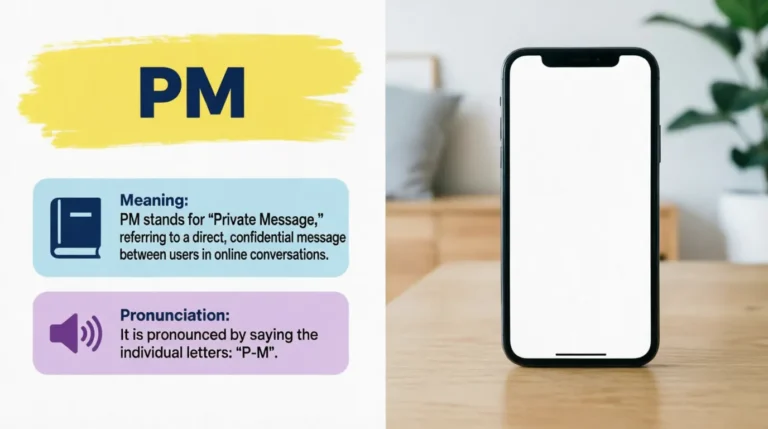
If you are wondering what does pm mean in text, the answer usually depends on the conversation.
Most commonly, PM means “private message” or “personal message,” especially when someone wants to continue a conversation away from a public comment section or group chat.
However, PM can also refer to “post meridiem,” meaning the afternoon or evening time after 12:00 noon, as in “Meet me at 7 PM.” Context makes the intended meaning easy to identify in most messages.
This guide explains what PM means in texting, social media, Snapchat, Instagram, dating apps, and other online conversations.
You’ll also find realistic examples, possible alternative meanings, natural responses, and tips for avoiding misunderstandings.
Quick Answer
PM most commonly means “private message” or “personal message” in texting and social media. It refers to sending someone a message privately rather than replying publicly. In time-related messages, PM means “post meridiem” and refers to the period between noon and midnight.
What Does PM Mean in Text?
In most online conversations, PM means “private message.”
A private message is a message sent directly to another person rather than posted where everyone can see it. Someone might ask you to “PM me” when they want to discuss something privately.
You can pronounce PM by saying the individual letters: “P-M.”
Tone and emotional meaning
PM itself is usually neutral. It does not automatically mean something romantic, secretive, suspicious, or serious.
Its tone depends on why someone wants to move the conversation into private messages. For example, a friend may PM you to share personal news, while someone on social media may ask you to PM them for more information.
Example:
“I don’t want to discuss this in the group. PM me when you’re free.”
Here, PM simply means send me a private message.
Origin and Background of PM
The meaning “private message” developed naturally through internet communication, forums, chat services, and social networking platforms.
As online communities created spaces where users could post publicly while also communicating privately, terms such as PM, DM, and private message became common.
Today, some platforms use the term DM, meaning “direct message,” more often than PM. However, many people still use PM casually as a general instruction to contact someone privately.
The time-related meaning of PM comes from the Latin expression post meridiem, meaning after midday.
How PM Is Used in Text Conversations
PM is commonly used when someone wants to move a conversation from a public space to a private one.
Friendly use
Person 1: Can you send me the photos?
Person 2: Sure, PM me your number.
In this conversation, the person wants to continue privately.
Casual use
Person 1: I know the answer to that.
Person 2: PM me 😂
This sounds relaxed and informal.
Personal or serious use
Person 1: I don’t really want to explain everything here.
Person 2: That’s okay. PM me if you want to talk.
Here, PM creates a more private space for the conversation.
Romantic use
PM does not automatically mean flirting. However, it can be used during a romantic conversation.
Person 1: You seem interesting.
Person 2: Haha, PM me then 😉
The wink emoji and previous conversation make this sound potentially flirtatious. The abbreviation itself remains neutral.
Humorous or sarcastic use
Person 1: I have some serious gossip.
Person 2: Don’t leave me hanging. PM me immediately 😂
The humor comes from the conversation, not from the meaning of PM itself.
What PM Means on Different Platforms
The basic meaning of PM usually remains private message, although platforms may officially use different terms.
On WhatsApp, people may say “PM me,” although the platform is already primarily based on private chats.
For example:
“Don’t send it in the group—PM me instead.”
This usually means sending the information directly rather than posting it in a group.
Snapchat
On Snapchat, PM generally means sending someone a private message or chat rather than communicating publicly through a story or another visible feature.
Instagram officially uses DMs, but people may still say PM casually.
“PM me for details.”
This usually means send me a direct/private message on Instagram.
TikTok
On TikTok, PM may mean contacting someone privately rather than discussing something in public comments.
The phrase “PM me” and “DM me” are often used interchangeably in casual conversation.
PM has been widely used on Facebook to mean sending someone a private message through Messenger or Facebook’s messaging system.
“Please PM me and I’ll explain.”
Discord
Discord users may use both PM and DM. In many communities, DM is more common, but PM can still be understood as a private message.
Dating Apps
On dating apps, PM usually means sending a private message to continue a conversation.
Whether the message is friendly, romantic, or flirtatious depends on the relationship and surrounding conversation—not simply on the word PM.
What Does PM Mean From a Girl or Guy?
PM generally means the same thing regardless of whether the sender is a girl, guy, or anyone else: send me a private message.
The sender’s gender does not change the definition.
What matters more is the context. Consider:
- What you were discussing before they said PM
- Whether they added emojis
- Whether the conversation was already flirtatious
- Whether they want to share something personal
- Whether they are moving the conversation away from a public space
For example:
“PM me when you get home 😊”
This could sound caring or affectionate.
Meanwhile:
“PM me the assignment details.”
This is simply practical.
The abbreviation has the same meaning, but the relationship and tone of the conversation affect how the message feels.
Other Possible Meanings of PM
PM can have more than one meaning. Context is important.
| Meaning | Context | Example |
|---|---|---|
| Private Message | Social media, forums, group chats | “PM me the details.” |
| Personal Message | Informal online communication | “Send me a PM when you’re free.” |
| Post Meridiem | Time and schedules | “The meeting starts at 3 PM.” |
| Prime Minister | Politics or news | “The PM gave a speech today.” |
| Project Manager | Work or professional discussions | “Ask the PM about the deadline.” |
The most common meaning in texting and social media conversations is “private message.”
How to Respond to PM
Your response should depend on what the person wants to discuss.
1. Casual response
“Sure, I’ll PM you.”
2. Friendly response
“Of course! Send me a message whenever you want.”
3. When you are confused
“Do you mean private message?”
This is useful if PM could have another meaning.
4. When you want them to message first
“Sure, send me a PM.”
5. When you’re busy
“Okay, PM me. I’ll reply when I’m free.”
6. When the conversation is personal
“You can PM me if you don’t want to talk about it here.”
7. Playful response
“Ooo, going private now? 😂 PM me.”
8. When you prefer not to continue privately
“I’d rather keep the conversation here, if that’s okay.”
You never have to move a conversation into private messages if you are uncomfortable doing so.
Similar Texting Terms and Differences
| Term | Meaning | Key Difference |
|---|---|---|
| PM | Private message | General term for messaging privately |
| DM | Direct message | Common on platforms such as Instagram and X |
| IM | Instant message | Focuses on real-time online messaging |
| Message me | Send me a message | More natural and less abbreviated |
| Inbox me | Send a private message | Often used on Facebook and similar platforms |
The biggest difference is that PM emphasizes privacy, while DM often refers to a platform’s direct messaging feature.
Common Misunderstandings About PM
One common mistake is assuming that PM always means private message.
If someone writes:
“See you at 6 PM.”
They are clearly talking about time, where PM means after noon.
Another misunderstanding is assuming that “PM me” automatically means something secretive or romantic. Usually, it simply means that the sender prefers to continue the conversation privately.
Capitalization usually does not change the meaning:
- PM
- pm
- Pm
However, lowercase pm is particularly common when referring to time.
Context should always come first.
Is PM Appropriate or Safe to Use?
PM is generally informal, polite, and safe to use in personal and social conversations.
It is appropriate when you want to ask someone to contact you privately. However, in professional communication, writing “send me a private message” or simply “please message me directly” may sound clearer.
Asking someone to PM you is not inherently suspicious.
Still, you should be cautious if a stranger repeatedly pressures you to move a conversation from a public space into private messages, especially if they request personal information, photos, money, passwords, or other sensitive details.
You can always choose not to respond or keep the conversation public.
Examples of PM in Text
- “PM me when you’re done with class.”
- “I don’t want to post my number here, so PM me instead.”
- “Can someone PM me the link?”
- “PM me the details and I’ll check it later.”
- “Haha, okay, now you have to PM me the whole story 😂”
- “If you need someone to talk to, PM me anytime.”
- “She asked me to PM her after the meeting.”
- “Don’t put the answer in the comments—PM me.”
- “PM me if you’re still interested 😊”
- “The event starts at 7 PM, so don’t be late!”
- “Can you PM me your username?”
- “I saw your comment. PM me and I’ll explain what happened.”
Frequently Asked Questions
Does PM mean private message or personal message?
Both meanings are used, but private message is generally the clearest and most common interpretation. In casual online communication, some people also use PM to mean personal message. In both cases, the basic idea is communicating privately rather than publicly.
Is PM the same as DM?
PM and DM are very similar. Both usually refer to private communication between users. DM means direct message and is the official or more common term on several modern social media platforms, while PM is a broader and older informal expression.
What does “PM me” mean from someone you like?
It usually means they want you to contact them privately. Whether this is romantic or flirtatious depends on the rest of the conversation, your relationship, emojis, and the topic being discussed. PM by itself does not automatically indicate romantic interest.
What does PM mean after a time?
When PM appears after a number representing time, it means post meridiem, referring to the period after noon and before midnight. For example, 8 PM means eight o’clock in the evening.
Can PM be used in professional messages?
Yes, but it is more common in informal communication. In a workplace message, “message me directly” or “send me a private message” may sound clearer, especially when communicating with people who may not use texting abbreviations regularly.
Should I PM a stranger who asks me to?
That depends on the situation. A simple private conversation is not automatically unsafe, but be cautious with strangers online. Avoid sharing passwords, financial information, private images, addresses, or other sensitive personal information with people you do not trust.
Conclusion
In texting, PM most commonly means “private message,” asking someone to communicate directly rather than in a public comment section or group conversation.
Its meaning is usually neutral, and context determines whether the conversation feels friendly, professional, personal, or romantic.
PM can also mean post meridiem when discussing time, as well as a few other meanings in specific contexts.
When you see PM, look at the surrounding message to identify the intended meaning. If someone asks you to PM them, you can respond naturally—or choose not to move the conversation private.

I am Ava Richardson, a passionate language writer who loves making English words and their meanings simple and easy to understand.
I create clear definitions, useful examples, and practical explanations to help readers improve their English vocabulary.