
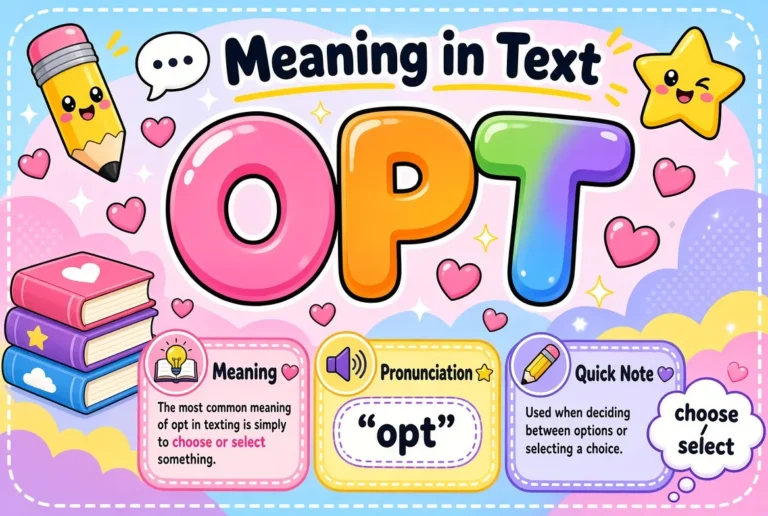
If you are wondering “what does opt mean in text from a girl,” the answer depends heavily on the sentence around it.
In most ordinary conversations, opt is not a special code or hidden romantic slang. It usually means to choose or decide to do one thing instead of another.
For example, a girl might text, “I think I’ll opt for the later movie,” meaning she has chosen the later movie.
However, OPT can occasionally have other meanings, especially as an abbreviation or within a specific online community.
The best way to understand it is to look at the full conversation. Her relationship with you, the topic being discussed, punctuation, and surrounding words can all clarify whether she simply means “choose” or is using OPT in a more specific context.
Quick Answer
OPT usually means “choose” or “select” in text. If a girl says she will “opt for” something, she means she prefers or chooses that option. The word itself does not normally carry a hidden romantic or gender-specific meaning. Context matters if OPT appears as a capitalized abbreviation.
What Does OPT Mean in Text?
The most common meaning of opt in texting is simply to choose or select something.
It is a regular English verb rather than a traditional texting abbreviation. People commonly use it in phrases such as:
- Opt for — choose one option over another
- Opt out — choose not to participate
- Opt in — choose to participate
It is pronounced “opt,” rhyming with “stopped” in many accents.
The tone is usually neutral and casual. Depending on the sentence, it can also sound slightly more deliberate than simply saying “pick” or “choose.”
Example:
Girl: “I might opt for staying home tonight.”
You: “That sounds like a good idea if you need to relax.”
Here, she simply means that she may choose to stay home.
Origin and Background of OPT
Opt is an established English word derived from the idea of making a choice. It was already part of standard English long before modern texting and social media.
Its use online did not create a completely new meaning. Instead, texting made short expressions such as “opt for,” “opt in,” and “opt out” convenient in quick conversations.
When written as OPT in capital letters, however, it may sometimes function as an abbreviation with a meaning specific to a school, workplace, immigration discussion, online community, or technical subject.
In those cases, the surrounding conversation is essential.
How OPT Is Used in Text Conversations
Choosing Between Options
This is the most common use.
Girl: “Pizza or burgers?”
Girl: “I’ll probably opt for pizza.”
She means she chooses pizza.
Choosing Not to Participate
Opt out means deciding not to take part.
Girl: “Everyone is going to the party, but I might opt out.”
You: “No worries. Do whatever feels right for you.”
This does not necessarily mean she is upset. She may simply prefer not to attend.
Choosing to Participate
Opt in means voluntarily deciding to join or receive something.
Girl: “I opted in for the group notifications.”
You: “That explains why you saw the update first.”
Casual or Slightly Formal Conversation
Some people naturally use opt because it sounds concise.
“I could go out, but I think I’ll opt for a quiet night.”
It can sound a little more polished than “pick,” but it is not unusually formal.
Romantic Context
OPT itself is not normally a romantic signal. However, the choice described may have romantic meaning.
Girl: “I could go with everyone else, but I’d rather opt for dinner with you.”
The word opt still means “choose.” The romantic meaning comes from her choosing to spend time with you.
Humorous or Sarcastic Use
OPT can sometimes appear in a joking sentence.
“After seeing how much that costs, I think I’ll opt for being broke instead 😂”
The word still means “choose,” while the humor comes from the rest of the message.
What OPT Means on Different Platforms
The basic meaning of opt generally remains the same across platforms. The surrounding topic may change, however.
On WhatsApp, OPT usually means choose, especially in ordinary personal conversations.
“I’ll opt for the blue one.”
Snapchat
On Snapchat, it may appear in quick conversations about plans, outfits, filters, food, or social activities.
“I might opt for this outfit instead.”
People may use opt for in comments, captions, and direct messages when discussing preferences.
“I always opt for the simpler look.”
TikTok
On TikTok, OPT may appear in comments or captions discussing choices, trends, products, or lifestyle decisions. Its meaning usually remains choose.
The word may appear in personal posts, group discussions, or more formal conversations. Context may make phrases such as opt in and opt out especially common.
Discord
On Discord, OPT can mean choose, but capitalized abbreviations may also have community-specific meanings. Check the server topic before assuming the standard definition.
Dating Apps
On dating apps, opt usually means choosing between plans or preferences.
“I’d opt for coffee over dinner on a first date.”
The word itself does not indicate romantic interest. The rest of the message provides the important clues.
What Does OPT Mean From a Girl or Guy?
OPT means essentially the same thing regardless of whether the sender is a girl or a guy. Gender does not change the standard meaning of the word.
What changes interpretation is the context of the choice.
For example:
“I opted to spend the evening with you 😊”
The word means “chose,” but the emoji and the decision to spend time with you may suggest warmth or interest.
Compare that with:
“I opted out of the group chat.”
This is practical and has no inherent romantic meaning.
When interpreting a message, look at:
- What the person is choosing
- Whether they are choosing you or something involving you
- The relationship between you
- Emojis and punctuation
- Previous messages
- Whether the conversation is playful, serious, or romantic
Other Possible Meanings of OPT
The standard texting meaning is “choose” or “select.” However, capitalized OPT can occasionally have a specific meaning depending on the subject.
| Meaning | Context | Example |
|---|---|---|
| Choose or select | General texting | “I’ll opt for the earlier flight.” |
| Opt out | Choosing not to participate | “I decided to opt out of the event.” |
| Opt in | Choosing to participate | “You can opt in for notifications.” |
| A context-specific abbreviation | School, work, technical, or community discussions | “My OPT status is still being processed.” |
If someone sends only “OPT” without a sentence, ask what they mean rather than guessing. Acronyms can have different meanings in different communities.
How to Respond to OPT
Your response should depend on what the person is choosing.
Casual
Girl: “I think I’ll opt for pizza.”
You: “Good choice!”
Friendly
Girl: “I might opt out tonight.”
You: “That’s totally fine. Get some rest!”
Interested
Girl: “I’d opt for hanging out with you instead 😊”
You: “I’d definitely be happy with that 😊”
Playful
Girl: “I’m opting for dessert.”
You: “Honestly, that might be the best decision of the day.”
Supportive
Girl: “I think I’ll opt out of the trip.”
You: “Do whatever feels best for you. No pressure.”
If You Are Confused
“When you say OPT, do you mean ‘choose,’ or are you using it as an abbreviation?”
When Choosing Between Two Things
“Sounds good. Which one are you leaning toward?”
Similar Texting Terms and Differences
| Term | Meaning | Key Difference |
|---|---|---|
| Opt | Choose or select | Often used as “opt for” |
| Pick | Choose something | More casual and direct |
| Choose | Select between options | The general standard term |
| Go with | Select or prefer something | Very conversational |
| Prefer | Like one option more than another | Focuses on preference rather than the final decision |
For example:
“I prefer pizza” means pizza is liked more.
But:
“I opted for pizza” usually means pizza was actually chosen.
Common Misunderstandings About OPT
One common mistake is assuming that opt is automatically secret texting slang.
In most cases, it is simply an ordinary English word meaning choose.
Another misunderstanding is believing that a girl using OPT must be sending a hidden romantic message.
The word itself does not communicate attraction. The meaning depends on what she is choosing.
Capitalization can also matter.
- opt usually appears as the ordinary English verb.
- OPT may indicate an abbreviation or acronym.
Do not assume that every capitalized version has the same meaning. If the message concerns education, work, technology, immigration, or a specialized community, OPT may have a topic-specific definition.
Is OPT Appropriate or Safe to Use?
OPT is generally safe, polite, and non-offensive. As an ordinary English word, it does not inherently suggest sexual content, threats, self-harm, abuse, or another concerning topic.
It is suitable for casual conversations and many professional situations.
However, context still matters when someone writes OPT as an acronym. In a specialized conversation, it may refer to something completely different from “choose.” If you are unsure, asking for clarification is the safest response.
In most everyday texts, though, there is nothing concerning about someone saying:
“I’ll opt for that one.”
Examples of OPT in Text
- “I think I’ll opt for the black jacket instead.”
- “We can go out, but honestly I might opt for a quiet night at home.”
- “If you want Italian food, I’ll opt for pasta.”
- “I’m going to opt out of the group trip this weekend.”
- “You can opt in whenever you’re ready.”
- “Between the two movies, I’d probably opt for the comedy.”
- “I was going to buy both, but my bank account made me opt for just one 😂”
- “I think I’ll opt for meeting you after work instead.”
- “She opted for the cheaper option and saved the rest.”
- “No pressure—I might just opt out this time.”
- “If we’re choosing a place together, I’d opt for somewhere quiet.”
- “I had three choices, but I finally opted for the first one.”
Frequently Asked Questions
What does OPT mean in a text message from a girl?
Most commonly, opt means “choose” or “select.” If she says she will “opt for” something, she is saying that she chooses or prefers that option. The word itself does not usually have a hidden meaning based on the fact that the sender is a girl.
Does OPT mean something romantic when a girl texts it?
Not by itself. OPT simply means “choose” in most conversations. However, if she says she is choosing to spend time with you or choosing you over another option, the context may have romantic or affectionate significance.
What does “opt for” mean in texting?
Opt for means to choose one option. For example, “I’ll opt for coffee” means “I’ll choose coffee.” It is commonly used when someone is deciding between two or more possibilities.
What does “opt out” mean in a text?
Opt out means deciding not to participate in something. Someone might opt out of a party, group activity, mailing list, or online service. It usually communicates a decision rather than anger or rejection.
Why did she write OPT in capital letters?
Capital letters may simply be a typing style, but OPT can also be an abbreviation with a specific meaning in certain subjects or communities. If the message does not clearly mean “choose,” consider the topic of the conversation or ask her what she means.
Should I ask a girl what OPT means if I am confused?
Yes. If the context does not make the meaning obvious, a simple question is better than guessing. You can say, “What do you mean by OPT here?” or “Do you mean choose, or is OPT an abbreviation?” This is natural and avoids misunderstandings.
Conclusion
When asking what does OPT mean in text from a girl, the most likely answer is simple: opt means to choose or select something, especially in phrases such as “opt for,” “opt in,” and “opt out.”
The sender’s gender does not change the basic definition. Instead, look at what she is choosing and the overall tone of the conversation.
If OPT appears in capital letters or does not fit the sentence, it may be a context-specific abbreviation.
When in doubt, asking for clarification is the easiest and most accurate response.

I am Ava Richardson, a passionate language writer who loves making English words and their meanings simple and easy to understand.
I create clear definitions, useful examples, and practical explanations to help readers improve their English vocabulary.