
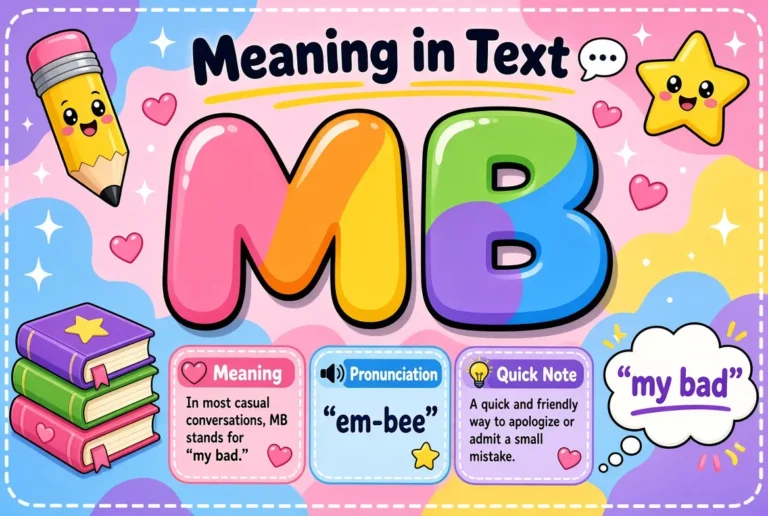
If you have received a message containing “MB” and are wondering what it means, the answer usually depends on the conversation.
In most casual text messages, MB means “my bad,” a quick and informal way to apologize for a mistake.
However, “MB” can have other meanings in specific situations, including “megabyte” in technology or data-related conversations.
The abbreviation is short, casual, and common in fast-moving chats, social media comments, and gaming conversations.
Understanding the surrounding message is the easiest way to interpret it correctly.
If you searched “what is mb mean in text,” this guide explains the most common meaning, alternative definitions, tone, examples, and natural ways to respond.
Quick Answer
MB usually means “my bad” in text messages. It is an informal way of saying “my mistake,” “sorry,” or “I messed up.” For example, “MB, I forgot to reply.” In technology or internet conversations, MB can also mean megabyte, so the surrounding context matters.
What Does MB Mean in Text?
In most casual conversations, MB stands for “my bad.”
“My bad” is an informal expression people use when admitting that they made a mistake. It can mean:
- My mistake
- Sorry about that
- I was wrong
- That was my fault
People usually pronounce the abbreviation by saying the individual letters “M-B,” while the full expression is pronounced “my bad.”
The tone is generally casual and friendly. Depending on the situation, it can sound genuinely apologetic, relaxed, humorous, or slightly dismissive if someone uses it after a more serious mistake.
Text-message example
Alex: You sent me the wrong address.
Jordan: MB 😭 I copied the old one.
Here, “MB” means “my bad” or “my mistake.”
Origin and Background of MB
The abbreviation “MB” developed naturally from the informal spoken expression “my bad.”
As texting and online communication encouraged shorter messages, people began using initials and abbreviations to communicate quickly.
“My bad” itself is an established informal English expression used to accept responsibility for an error.
The exact point when “MB” became widely used in texting is difficult to identify, and there is no need to assume a specific origin date.
Today, the abbreviation appears most naturally in casual chats where speed and informality are more important than formal grammar.
How MB Is Used in Text Conversations
MB is most often used after someone notices or admits a mistake.
Casual apology
Sam: You were supposed to bring the tickets.
Chris: MB, I completely forgot.
The sender accepts responsibility without making the conversation overly serious.
Friendly correction
Taylor: The meeting starts at 4, right?
Morgan: Nope, it’s at 3.
Taylor: Oh MB, I read the schedule wrong.
Here, MB simply means “my mistake.”
Humorous use
Friend 1: You ate the last slice of pizza?
Friend 2: MB 😂
The apology is playful rather than deeply serious.
Romantic or relationship conversations
Person 1: You said you’d call me last night.
Person 2: MB 🥲 I fell asleep after work.
In this situation, the meaning remains “my bad,” but the emoji and relationship context can make the apology sound more affectionate or sincere.
Sarcastic or dismissive use
Sometimes a person may write “mb” in a way that sounds less apologetic:
Person 1: You deleted all my work.
Person 2: mb
The abbreviation itself still means “my bad,” but using only two letters without explanation can sound careless or dismissive when the mistake is serious.
What MB Means on Different Platforms
The meaning of MB generally stays the same across platforms, but the surrounding type of conversation may change how it is interpreted.
On WhatsApp, MB commonly means “my bad” in casual conversations with friends, family members, or groups.
Snapchat
MB often appears in quick, informal messages and usually means “my bad.” Because Snapchat conversations are often brief, users may use abbreviations more frequently.
In Instagram DMs and comments, MB can mean “my bad” when someone corrects themselves or apologizes for a small mistake.
TikTok
TikTok comments may use MB as a quick reaction after someone realizes they misunderstood something or made an incorrect statement.
On Facebook Messenger or in casual comments, MB can mean “my bad,” although some users may simply write the full phrase.
Discord
MB is common in fast-moving conversations, gaming communities, and group chats where users quickly admit mistakes.
For example:
Player: I attacked the wrong team.
Player: MB 😭
Dating Apps
In dating conversations, MB can mean “my bad” after a forgotten reply, misunderstanding, or minor mistake.
However, because dating conversations can be more sensitive, context and tone matter. A brief “mb” after repeatedly ignoring someone may not feel like a particularly sincere apology.
What Does MB Mean From a Girl or Guy?
MB has the same basic meaning regardless of whether it comes from a girl, guy, or anyone else. It usually means “my bad.”
Gender does not determine the meaning. Instead, pay attention to the relationship and conversation.
For example:
MB 😂 may suggest that the person sees the mistake as funny.
MB, I genuinely forgot. may sound more sincere.
MB 🥺 may make the message sound softer or more apologetic.
MB. with a period may sound more abrupt, depending on the conversation.
If you are unsure what the sender means, read the messages immediately before and after “MB.” Context is much more useful than trying to interpret the abbreviation based on who sent it.
Other Possible Meanings of MB
Although “my bad” is the most common meaning of MB in casual texting, the abbreviation can mean other things in specific contexts.
| Meaning | Context | Example |
|---|---|---|
| My bad | Casual apology or admitting a mistake | “MB, I sent the wrong screenshot.” |
| Megabyte | Technology, files, storage, or internet data | “The file is only 20 MB.” |
| Maybe | Occasionally used informally, depending on a person’s texting style | “MB later, not sure yet.” |
The context is important. If someone writes:
“The video is 500 MB,”
they are clearly talking about megabytes, not saying “my bad.”
Similarly, “maybe” is sometimes shortened in personal texting styles, but it is much less universally understood than “my bad” or “megabyte.”
How to Respond to MB
Your response should match the seriousness of the situation.
1. Casual response
Them: MB, I forgot.
You: No worries!
2. Friendly response
Them: MB, I gave you the wrong time.
You: It’s okay, thanks for letting me know.
3. Funny response
Them: MB 😂
You: I’ll forgive you this time 😂
4. Reassuring response
Them: MB, I messed that up.
You: Don’t worry, everyone makes mistakes.
5. Slightly teasing response
Them: MB 😭
You: You better be sorry 😭😂
6. Romantic response
Them: MB, I fell asleep and missed your call.
You: You’re forgiven ❤️ Just call me later.
7. Asking for clarification
If the abbreviation appears without enough context:
You: MB as in “my bad”?
This is a simple way to avoid misunderstanding the message.
8. Serious response
If the mistake genuinely affected you:
Them: MB.
You: I understand, but that situation was important to me.
A short abbreviation may be fine for a small mistake, but more serious situations sometimes deserve a fuller apology.
Similar Texting Terms and Differences
| Term | Meaning | Key Difference |
|---|---|---|
| MB | My bad | Usually admits a mistake casually |
| MYM | My mistake | More direct and less commonly used as a standard abbreviation |
| Sry / Sorry | Apology | Can express regret without specifically admitting fault |
| Oops | I made a mistake | Often reacts to a mistake rather than directly apologizing |
| NP | No problem | Common response when someone apologizes |
For example:
MB, I forgot focuses on accepting responsibility.
Sorry, I forgot focuses more directly on apologizing.
Oops, I forgot can sound surprised or playful.
Common Misunderstandings About MB
One common mistake is assuming that MB always means “my bad.” While that is usually correct in casual conversation, it may mean megabyte when discussing technology, file sizes, storage, or mobile data.
Capitalization usually does not change the meaning:
- MB
- mb
- Mb
However, capitalization can matter in technical writing because abbreviations for data units may follow specific conventions.
Another misunderstanding is assuming that “MB” automatically represents a serious apology.
In reality, “my bad” is usually casual. If the situation is serious, the sender’s explanation and overall tone matter more than the abbreviation itself.
Also, not everyone uses MB the same way. Some people prefer writing “my bad,” while others may use the initials frequently in quick conversations.
Is MB Appropriate or Safe to Use?
MB is generally safe, informal, and non-offensive. When it means “my bad,” it is simply a casual way of admitting a mistake.
It is appropriate for conversations with:
- Friends
- Classmates
- Family members
- Gaming groups
- Casual social media chats
It may be less suitable for professional or formal situations. For example, if you make a significant mistake at work, writing only “MB” could sound too casual.
A more appropriate response might be:
“I’m sorry. That was my mistake, and I’ll correct it.”
MB does not normally suggest self-harm, threats, abuse, or sexual content. Its meaning is generally harmless, although the surrounding conversation should always be considered.
Examples of MB in Text
Here are some realistic ways people use MB in messages:
- MB, I thought the appointment was tomorrow.
- Wait, mb 😭 I read your message completely wrong.
- MB bro, that one was definitely my fault.
- I sent the wrong link. MB 😂
- MB, I didn’t realize you were waiting for me.
- Ohhh MB, now I understand what you meant.
- MB 😅 I accidentally left you on read.
- That’s my bad—MB for the confusion.
- MB, I picked the wrong option again.
- Sorry, MB. I should have checked first.
- MB 😭 I genuinely forgot we made plans.
- The file is 200 MB, so it might take a minute to send.
Notice that the final example means megabytes, not “my bad.” The surrounding context makes the difference clear.
Frequently Asked Questions
Is MB short for “my bad” in text?
Yes. In most casual text conversations, MB means “my bad.” People use it to admit a mistake or accept responsibility for something that went wrong. It is similar to saying “my mistake” or “sorry,” although the tone is usually more casual and relaxed.
What does “mb” mean from someone apologizing?
If someone writes “mb” after making a mistake, they almost certainly mean “my bad.” The level of sincerity depends on the rest of the message, the situation, and whether they provide an explanation or make an effort to correct the mistake.
Does MB always mean “my bad”?
No. Although “my bad” is the most common casual texting meaning, MB can also mean megabyte when discussing file sizes, internet data, storage, photos, or videos. Always check the topic of the conversation before deciding what it means.
What should I reply when someone says MB?
For a small mistake, you can say “No worries,” “It’s okay,” or “All good.” If you want to be playful, you might say “I’ll forgive you this time 😂.” If the issue is more serious, respond honestly rather than feeling required to dismiss the situation.
Is MB rude?
MB is not inherently rude, but it can sound too casual in certain situations. Saying “mb” after a minor mistake is usually fine. Using only “mb” after causing a serious problem may make the sender appear dismissive or unwilling to offer a proper apology.
What does MB mean on Snapchat or Instagram?
On Snapchat and Instagram, MB usually means “my bad.” The platform itself normally does not change the meaning. Look at the conversation to determine whether the person is apologizing, correcting themselves, joking about a mistake, or referring to something technical.
Conclusion
In texting, MB most commonly means “my bad,” a casual way of saying “my mistake” or admitting responsibility for an error.
It is generally friendly, informal, and harmless, but the tone can range from genuinely apologetic to humorous or slightly dismissive depending on context.
In technology-related conversations, MB may instead mean megabyte.
The easiest way to understand the abbreviation is to look at the surrounding topic, punctuation, emojis, and relationship between the people chatting.
When in doubt, simply ask what the sender means.

I am Ava Richardson, a passionate language writer who loves making English words and their meanings simple and easy to understand.
I create clear definitions, useful examples, and practical explanations to help readers improve their English vocabulary.