
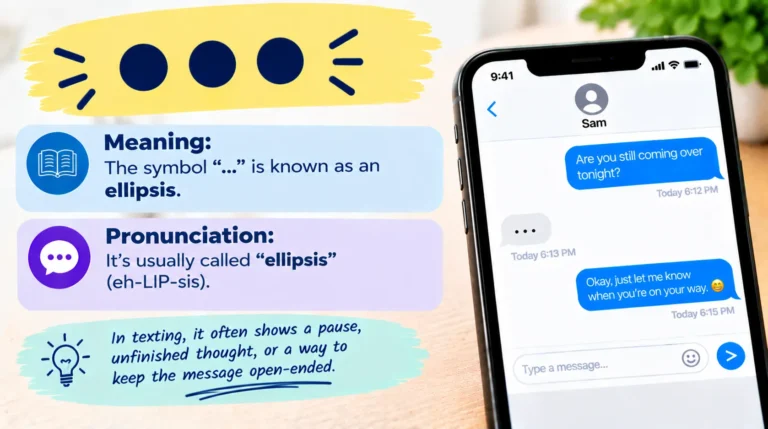
If you are wondering “in a text what does mean”, you may be referring to three dots: “…”, also called an ellipsis.
In text messages, these dots can have several meanings depending on the conversation.
They may show a pause, hesitation, an unfinished thought, disappointment, awkwardness, sarcasm, suspense, or simply that someone has more to say.
Unlike many texting abbreviations, “…” does not have one fixed definition. The relationship between the people, the message before it, punctuation, and emojis can all change its tone.
Sometimes it is completely harmless, while in other situations it can make a message sound cold or uncomfortable.
Understanding the surrounding conversation is the best way to interpret it correctly.
Quick Answer
“…” in a text is called an ellipsis and usually shows a pause, hesitation, or unfinished thought. Depending on context, it can also suggest awkwardness, disappointment, suspense, sarcasm, or that the sender is unsure what to say. The conversation and tone determine its exact meaning.
What Does “…” Mean in Text?
The symbol “…” is known as an ellipsis.
In traditional writing, an ellipsis often indicates that words have been left out or that a sentence trails off. In texting, however, people use it much more freely.
The most common meaning is:
A pause or an unfinished thought.
For example:
Alex: Are you coming tonight?
Sam: I don’t know…
Here, the three dots suggest that Sam is uncertain or still thinking.
The tone can range from neutral to emotional. Compare:
- Okay… — possibly hesitant or suspicious.
- Well… maybe. — thinking or uncertainty.
- That’s interesting… — possibly doubtful or sarcastic.
- I miss you… — a soft, emotional pause.
There is no pronunciation issue in normal conversation because people usually do not say the dots aloud. If necessary, they may call them “three dots” or “an ellipsis.”
Origin and Background of “…”
The ellipsis existed in formal writing long before texting and social media. Traditionally, writers used it to show omitted words, pauses, or thoughts that intentionally trailed off.
As texting became more conversational, people began using the ellipsis to represent pauses and emotions that would normally be communicated through voice, facial expressions, or silence.
Its use in messaging is flexible rather than officially standardized. Different people also develop different texting habits, so one person’s “…” may simply be their normal punctuation style while another person may use it to express discomfort or hesitation.
How “…” Is Used in Text Conversations
Showing Hesitation
This is one of the most common uses.
Person 1: Did you like the movie?
Person 2: It was… okay.
The dots suggest that the person is choosing their words carefully.
Creating a Pause
Sometimes an ellipsis makes a message feel slower or more conversational.
I was going to tell you something…
The reader may expect another message.
Showing an Unfinished Thought
A person may stop before finishing what they intended to say.
I just wish things were different…
This can suggest sadness or emotional uncertainty.
Creating Suspense
The dots can build anticipation.
Guess what happened today…
The sender is encouraging the other person to ask what happened.
Expressing Awkwardness
Sometimes “…” represents silence.
Person 1: I accidentally texted my teacher instead of my friend.
Person 2: …
Here, the ellipsis can mean, “I don’t know what to say.”
Suggesting Disappointment or Doubt
Context can make the dots sound negative.
Oh… I thought you were coming.
This may suggest disappointment.
Adding Sarcasm
Sometimes an ellipsis creates a skeptical tone.
Sure… because that sounds like a great idea.
The meaning depends heavily on the conversation.
What “…” Means on Different Platforms
The basic meaning of an ellipsis usually stays the same across platforms, but the communication style of each platform can affect how people interpret it.
On WhatsApp, “…” commonly shows hesitation, a pause, or an unfinished thought. It may also appear in emotional conversations.
Snapchat
Snapchat conversations are often quick and informal. An ellipsis may suggest awkwardness, suspense, or that someone is about to send another message.
In Instagram direct messages, “…” can make a response feel playful, curious, hesitant, or slightly dramatic.
For example:
You really posted that…
The meaning could be humorous, surprised, or critical depending on the relationship.
TikTok
On TikTok, an ellipsis can be used in comments and messages to show disbelief or a speechless reaction.
The ending of this video…
This may imply that the person does not know how to describe their reaction.
Some Facebook users use ellipses as ordinary punctuation, especially in longer messages. Therefore, “…” does not automatically mean that the sender is upset.
Discord
On Discord, ellipses can show hesitation, a pause, sarcasm, or a reaction to something unexpected. In fast-moving group chats, context is especially important.
Dating Apps
On dating apps, “…” can sometimes create a softer or more suggestive tone.
For example:
Maybe we should meet sometime…
This may indicate shyness, flirtation, or uncertainty. It does not automatically have a romantic meaning.
What Does “…” Mean From a Girl or Guy?
The meaning of “…” does not automatically change based on whether it comes from a girl or a guy.
The more important clues are:
- Your relationship with the sender
- The topic of the conversation
- Their usual texting style
- The words before and after the ellipsis
- Emojis
- Previous messages
- Whether they normally use lots of punctuation
For example:
I guess that’s okay…
could indicate disappointment from anyone.
However:
I guess that’s okay… 😊
may sound softer or friendlier because of the emoji.
Similarly:
I guess that’s okay…
after an argument may suggest that the person is unhappy or unconvinced.
Context matters more than gender.
Other Possible Meanings of “…”
| Meaning | Context | Example |
|---|---|---|
| Pause or hesitation | The sender is thinking | “Well… I’m not sure.” |
| Unfinished thought | The sentence trails off | “I just thought maybe…” |
| Awkward silence | The sender does not know what to say | “You told her that…?” |
| Suspense | The sender wants attention or anticipation | “Wait until you hear this…” |
| Disappointment | The message expresses mild sadness | “Oh… I was expecting you.” |
| Skepticism or sarcasm | Context suggests disbelief | “Sure… whatever you say.” |
The most common texting meaning is a pause, hesitation, or unfinished thought.
How to Respond to “…”
Your response should depend on the message surrounding the ellipsis.
Casual
Them: Maybe…
You: Haha, take your time and decide.
Curious
Them: Something happened today…
You: What happened? Tell me!
Supportive
Them: I don’t know what to do…
You: That’s okay. You can talk to me if you want.
Playful
Them: You won’t believe what I did…
You: Now you have to tell me 😂
Clarifying
Them: Okay…
You: Is everything okay?
Romantic
Them: I was thinking about you…
You: Really? What were you thinking? 😊
When the Meaning Is Unclear
Them: Well…
You: What do you mean?
When Someone Seems Upset
Them: It’s fine…
You: You seem a little upset. Want to talk about it?
Similar Texting Terms and Differences
| Term | Meaning | Key Difference |
|---|---|---|
| … | Pause or trailing thought | Can express many emotions depending on context |
| Hmm | Thinking or uncertainty | Usually represents a thoughtful sound |
| Umm | Hesitation | Often imitates spoken hesitation |
| Idk | I don’t know | Directly states uncertainty |
| Hmm… | Thinking with a pause | Combines a reaction with trailing uncertainty |
| — | Interrupted or changing thought | A dash often creates a sharper break than an ellipsis |
Common Misunderstandings About “…”
One of the biggest mistakes is assuming that every ellipsis means the sender is angry.
Some people naturally write messages such as:
Okay… I’ll call you later…
without intending any negative emotion.
Another common misunderstanding is believing that “…” always means sarcasm. While it can make a sentence sound sarcastic, the surrounding words must support that interpretation.
Capitalization does not significantly change the meaning:
- okay…
- OKAY…
- Okay…
However, capital letters may make the overall message feel stronger.
The number of dots can also vary. Some people write four or more dots for style:
Wait….
This usually does not create a completely different meaning.
Is “…” Appropriate or Safe to Use?
An ellipsis is generally safe, polite, and informal-to-neutral punctuation.
It is acceptable in casual texting, social media messages, and many everyday conversations. However, excessive use can sometimes make writing look uncertain, passive-aggressive, or overly dramatic.
In professional communication, use it carefully. A clear sentence is often better than repeatedly ending messages with “…”.
For example:
Please send me the report…
may accidentally sound impatient or incomplete.
A period may be clearer:
Please send me the report.
The ellipsis itself does not indicate danger, threats, self-harm, abuse, or sexual content. However, the words surrounding it may reveal an emotional concern.
For example:
I don’t think I can do this anymore…
deserves more attention than the punctuation alone. If someone appears distressed, it can be appropriate to ask directly and supportively whether they are okay.
Examples of “…” in Text
- I’m not sure… maybe we should wait until tomorrow.
- You did WHAT…?!
- Well… that was unexpected.
- I wanted to ask you something…
- Okay… I understand now.
- Hmm… I don’t think that’s the best idea.
- I thought you said you weren’t coming…
- Wait… are you serious?
- I miss those days…
- Sure… if you really think that will work.
- There’s something I need to tell you… but I’m nervous.
- …I honestly don’t know what to say.
Frequently Asked Questions
What does “…” mean when someone texts it by itself?
When someone sends only “…”, it often represents silence, awkwardness, disbelief, or not knowing what to say. It can also be a reaction to something surprising. The previous message is especially important because the dots alone do not have one fixed emotional meaning.
Does “…” mean someone is mad?
Not necessarily. Some people naturally use ellipses in almost every message. However, if the sender normally does not use them and suddenly writes something like “Okay…”, the tone could suggest hesitation, disappointment, or irritation.
Is an ellipsis passive-aggressive in texting?
It can sometimes sound passive-aggressive, especially after short responses such as “Fine…” or “Sure…”. However, it is not automatically passive-aggressive. Look at the person’s normal writing style and the context before assuming negative intent.
What does “okay…” mean in a text?
“Okay…” can mean simple acceptance, but the ellipsis may add hesitation, uncertainty, disappointment, or suspicion. Compare it with the more direct “Okay.” The surrounding conversation usually reveals whether the sender is genuinely comfortable with the situation.
What does “…” mean after a compliment?
After a compliment, an ellipsis may suggest shyness, uncertainty, emotional softness, or playful suspense. For example, “You’re really sweet…” could sound warm and affectionate, while “You think I’m cute…?” may show surprise or uncertainty.
Should I use “…” in professional messages?
You can use an ellipsis occasionally, but it is usually better to avoid overusing it in professional communication. It may make a message seem unfinished or unclear. Use complete sentences and clear punctuation when communicating with colleagues, clients, teachers, or employers.
Conclusion
In a text, “…” usually represents a pause, hesitation, or unfinished thought, but its emotional meaning can change with context
. It may communicate uncertainty, awkward silence, suspense, disappointment, sarcasm, or a softer conversational tone.
The sender’s usual writing habits and the surrounding messages are more important than the dots themselves.
If you are unsure what someone means, avoid overthinking the punctuation and respond naturally or ask for clarification.
A simple question such as “What do you mean?” can often clear up the meaning immediately.

I am Ava Richardson, a passionate language writer who loves making English words and their meanings simple and easy to understand.
I create clear definitions, useful examples, and practical explanations to help readers improve their English vocabulary.