
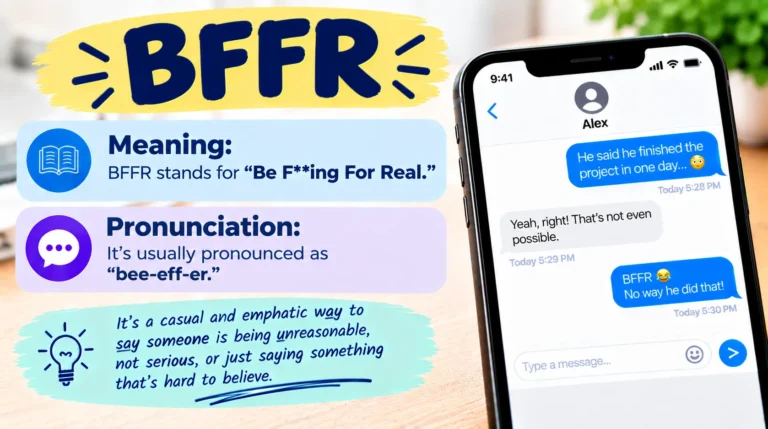
If someone has sent you “BFFR” in a text, Snapchat message, TikTok comment, or Instagram conversation, they are usually reacting strongly to something they think is unrealistic, exaggerated, or simply not believable.
The abbreviation is common in casual online communication and can range from playful teasing to blunt criticism.
So, what does bffr mean in text? In most conversations, it means “Be F*ing For Real”**—a strong way of telling someone to be serious or realistic.
The exact tone depends heavily on the relationship between the people, the surrounding conversation, punctuation, and emojis.
Understanding BFFR can help you tell whether someone is joking with you, disagreeing with you, or expressing genuine disbelief.
Quick Answer
BFFR means “Be F*ing For Real.”** It is an informal expression used when someone thinks another person is being unrealistic, exaggerating, joking, or saying something difficult to believe. It can sound playful among friends, but depending on the tone and context, it can also sound sarcastic, dismissive, or rude.
What Does BFFR Mean in Text?
BFFR stands for “Be F*ing For Real.”**
It is an emphatic version of “Be for real” or “Seriously?” People use it when they strongly disagree with something, find a statement unbelievable, or want another person to stop exaggerating.
It is usually pronounced by saying the individual letters: “B-F-F-R.” Some people may also understand it immediately from context without saying the abbreviation aloud.
Tone and Emotional Meaning
BFFR often communicates one or more of these feelings:
- Disbelief
- Surprise
- Amusement
- Frustration
- Sarcasm
- Playful teasing
- Strong disagreement
The phrase is stronger than simply saying “Be serious.” The profanity adds emphasis, although the abbreviation can make it feel slightly less direct than writing the full phrase.
Example:
Alex: “I think I can finish this entire project in 20 minutes.”
Sam: “BFFR 😭”
Here, Sam probably does not literally expect Alex to become more honest. Instead, BFFR means something closer to “Seriously? That is not realistic.”
Origin and Background of BFFR
BFFR developed from the longer spoken expression “be f*ing for real,”** which itself is an intensified version of “be for real.”
The exact first origin or date of the abbreviation is difficult to establish reliably. Like many pieces of internet slang, it became more recognizable through casual online conversations, memes, short-form videos, comments, and social media culture rather than through one clearly documented creator.
Its popularity is closely connected to the internet’s preference for short, expressive reactions. Instead of writing a full sentence such as “Are you seriously saying that right now?”, someone can simply reply:
“BFFR.”
The abbreviation works especially well as a quick reaction because its meaning is strongly emotional and easy to understand from context.
How BFFR Is Used in Text Conversations
BFFR is usually a reaction rather than a detailed response. People commonly use it after someone makes a bold claim, exaggerates, says something unlikely, or makes a questionable decision.
Friendly and Casual Use
Among friends, BFFR can be playful.
Jamie: “I barely studied, but I think I’ll get 100%.”
Taylor: “BFFR 😂”
Taylor may simply be teasing Jamie.
Humorous Use
People also use BFFR when reacting to an obviously exaggerated statement.
Chris: “I’m never going to procrastinate again.”
Morgan: “BFFR 💀”
The response suggests that Morgan finds the statement funny and difficult to believe.
Sarcastic Use
BFFR can express sarcastic disbelief.
Person 1: “He said he didn’t reply because he was too busy.”
Person 2: “BFFR. He was online all day.”
Here, the speaker strongly doubts the explanation.
Negative or Frustrated Use
Sometimes BFFR is less playful.
Person 1: “You should just ignore the deadline.”
Person 2: “BFFR. That’s terrible advice.”
In this situation, the abbreviation signals genuine disagreement.
Romantic or Relationship Conversations
BFFR can also appear in flirting or relationship discussions.
A: “You didn’t miss me at all.”
B: “BFFR 😭 You know I did.”
Here, it means something like “Come on, be serious—you know that’s not true.”
The tone is affectionate rather than hostile.
What BFFR Means on Different Platforms
The core meaning of BFFR generally stays the same across platforms. What changes is the style and context in which people use it.
On WhatsApp, BFFR is often used in private chats and group conversations as a quick reaction to something surprising or unrealistic.
Because WhatsApp conversations are often between people who know each other well, the tone may be easier to interpret from the relationship.
Snapchat
On Snapchat, BFFR may appear as a short reply to a Snap, chat message, or exaggerated story. It often carries a playful or teasing tone, especially when combined with emojis.
“BFFR 😭😭”
usually sounds more amused than:
“BFFR.”
On Instagram, people may use BFFR in direct messages, comments, or replies to posts and Reels.
It can be a reaction to an opinion, a dramatic statement, or something the commenter considers unrealistic.
TikTok
TikTok is a common environment for expressive reaction slang. BFFR may appear in comments when viewers disagree with a creator’s statement or find a situation unbelievable.
The abbreviation can be humorous, sarcastic, or critical depending on the content.
BFFR is less dependent on the platform itself and more dependent on the age and communication style of the people involved. Younger users and people familiar with current internet slang are more likely to recognize it immediately.
Discord
On Discord, BFFR is often used during fast-moving conversations, gaming discussions, debates, and jokes.
For example:
“You think you can beat everyone without practicing? BFFR.”
Dating Apps
On dating apps, BFFR may be playful when responding to an exaggerated compliment, joke, or claim.
Person: “I’m probably the funniest person you’ll ever meet.”
Reply: “BFFR 😂”
However, because two people may not know each other’s sense of humor yet, it can occasionally sound harsher than intended.
What Does BFFR Mean From a Girl or Guy?
BFFR generally means the same thing regardless of whether it comes from a girl, guy, or anyone else.
The important clues are relationship, context, punctuation, emojis, and the conversation immediately before it.
For example:
“BFFR 😭😂”
is often playful, amused, or teasing.
Meanwhile:
“BFFR.”
with no emoji may feel more serious or dismissive, particularly during an argument.
A romantic relationship can also change the emotional interpretation:
“BFFR, you know you’re my favorite.”
This sounds affectionate.
But during a disagreement:
“BFFR. You can’t honestly think that.”
The same abbreviation becomes much more confrontational.
Rather than focusing on the sender’s gender, look at what they are responding to and how the conversation was already going.
Other Possible Meanings of BFFR
The overwhelmingly common meaning of BFFR in modern texting and social media is “Be F*ing For Real.”** It is not generally used as a widely recognized texting abbreviation with several unrelated meanings.
| Meaning | Context | Example |
|---|---|---|
| Be F*ing For Real** | Most common texting and social media meaning; expresses disbelief or frustration | “You think that’s going to work? BFFR.” |
| Be For Real | A less profane interpretation sometimes intended by users who avoid the full phrase | “BFFR, that price is way too high.” |
The first meaning is the most common interpretation in texting.
In many cases, the abbreviation still carries the stronger tone of the full expression even when the user does not consciously intend to emphasize the profanity.
How to Respond to BFFR
Your best response depends on why the person said it.
If They Are Joking
Them: “BFFR 😂”
You: “Okay, okay, maybe I exaggerated a little.”
If You Want to Be Funny
Them: “BFFR 💀”
You: “I am being real. My confidence is just ahead of the evidence.”
If They Doubt You
Them: “BFFR, you actually did that?”
You: “Yes 😭 I swear I’m serious.”
If You Were Exaggerating
Them: “BFFR.”
You: “Fair enough. I was being dramatic.”
If You Are Confused
Them: “BFFR”
You: “Wait, do you think I’m joking?”
If You Want to Keep Things Friendly
Them: “BFFR 😂”
You: “You don’t believe me at all, do you?”
If the Tone Feels Too Harsh
Them: “BFFR.”
You: “I’m being serious. Why do you think I’m not?”
If It Is Part of Flirting
Them: “BFFR, you didn’t miss me.”
You: “I did, actually. More than I’d like to admit 😭”
Similar Texting Terms and Differences
| Term | Meaning | Key Difference |
|---|---|---|
| FR | For real | Usually asks for confirmation or emphasizes honesty; less confrontational |
| BSFR | Be so for real | Similar disbelief, but usually without the stronger profanity |
| Seriously? | Is that true or are you being serious? | A complete expression that can be neutral or sarcastic |
| Cap | A lie or false statement | Directly suggests that something is untrue |
| No way | Strong disbelief or surprise | Can express amazement without criticizing the speaker |
BFFR is distinctive because it usually tells the other person that their statement sounds unrealistic, exaggerated, or difficult to take seriously.
Common Misunderstandings About BFFR
One common mistake is assuming that BFFR always means the sender is angry. It can certainly sound irritated, but among friends it is often a joke.
Another misunderstanding is treating BFFR as the same as BFF, which means “best friends forever.” Although the abbreviations look similar, they have completely different meanings.
Capitalization usually does not change the meaning:
- BFFR
- bffr
- Bffr
All generally mean the same thing.
However, punctuation and emojis can change the tone.
“bffr 😭😂” — likely playful or amused
“BFFR.” — potentially serious or irritated
“BFFR???!” — strong disbelief or shock
Context is essential. If someone uses BFFR after a joke, it may be friendly. If they use it during a heated disagreement, it may be dismissive or confrontational.
Is BFFR Appropriate or Safe to Use?
BFFR is highly informal and contains an implied profanity, so it is best suited to casual conversations with friends, social media, and informal online spaces.
It may be inappropriate for:
- Professional emails
- Workplace conversations
- Formal academic communication
- Messages to teachers or supervisors
- Conversations with people who may dislike profanity
BFFR is not normally associated with self-harm, threats, abuse, or sexual content. Its main concern is tone. Depending on context, it can sound rude or dismissive because it suggests that the other person is not being realistic or honest.
If you are unsure how someone will react, a softer alternative such as “Be serious”, “Really?”, or “Are you for real?” may be better.
Examples of BFFR in Text
- “You think you’re going to finish all that homework tonight? BFFR 😭”
- “BFFR, that movie was not as bad as you’re making it sound.”
- “He said he doesn’t care, but he checked your profile again. BFFR.”
- “You haven’t slept all night and you’re saying you’re not tired? BFFR 😂”
- “BFFR 😭 You cannot wear that and tell me you don’t want attention.”
- “I know what you’re saying, but BFFR for a second—that plan has no chance.”
- “BFFR, you really thought nobody would notice?”
- “She said she’s never buying coffee again. BFFR, see you at the café tomorrow.”
- “BFFR 💀 You barely opened the book.”
- “You didn’t miss me? BFFR, I saw your message the second you sent it.”
- “I was going to clean my room today.”
“BFFR. You said that yesterday too.” - “BFFR, though—are you actually serious about moving?”
Frequently Asked Questions
Is BFFR rude in a text?
BFFR can sound rude depending on tone and context. Between close friends, it is often playful teasing. During an argument or when sent without any friendly context, however, it may sound dismissive, sarcastic, or aggressive. Emojis, punctuation, and the relationship between the speakers can significantly affect how it is received.
What does BFFR mean from a friend?
From a friend, BFFR usually means “Be F*ing For Real”** and often expresses playful disbelief. Your friend may think you are exaggerating, joking, making an unrealistic claim, or being dramatic. If the conversation is normally friendly, it is often intended as teasing rather than a serious insult.
Does BFFR mean the same as BFF?
No. BFF means “best friends forever,” while BFFR usually means “Be F*ing For Real.”** The extra letters completely change the meaning. BFF refers to a close friendship, whereas BFFR is a reaction expressing disbelief, frustration, or a request for someone to be realistic.
What does “BFFR 😭” mean?
When BFFR is followed by the crying emoji, it often signals exaggerated amusement or disbelief rather than genuine anger. The sender may be saying something like “Come on, seriously?” or “That is so unbelievable.” The emoji often makes the message feel more playful, although the wider conversation still matters.
Can I use BFFR at work or school?
BFFR is best avoided in formal workplace or school communication because it is very informal and commonly represents profanity. It may be acceptable in a casual conversation with friends or classmates who understand the slang, but it is safer to use phrases such as “Seriously?” or “Are you being realistic?” in professional settings.
What should I say if someone texts me BFFR?
First, look at what you said immediately before they used it. If you were joking or exaggerating, you can respond playfully. If you were serious, you can clarify your point. If their tone seems negative, calmly ask what they disagree with instead of assuming that they are angry.
Conclusion
BFFR most commonly means “Be F*ing For Real”** in text and online conversations.
People use it to express disbelief, challenge an unrealistic statement, react to exaggeration, or tease someone playfully.
Its meaning usually stays consistent across social media platforms, but its tone can shift from funny and friendly to sarcastic or frustrated.
When you receive BFFR, check the message that came before it, along with punctuation, emojis, and your relationship with the sender.
A playful response is often appropriate, but clarification is best when the tone is unclear.

I am Ava Richardson, a passionate language writer who loves making English words and their meanings simple and easy to understand.
I create clear definitions, useful examples, and practical explanations to help readers improve their English vocabulary.