
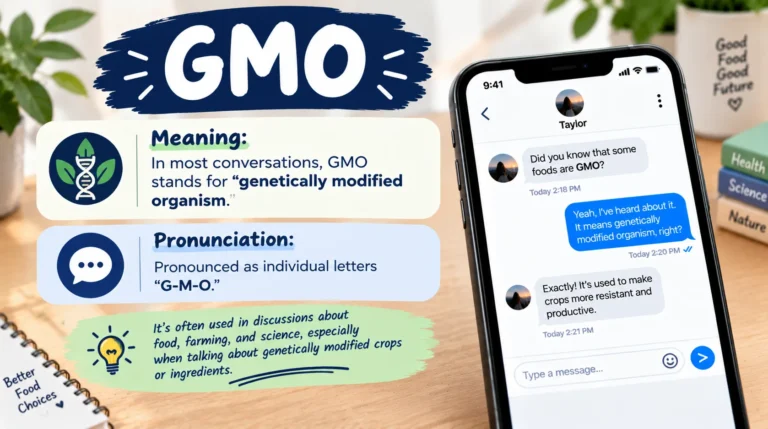
If you received “GMO” in a message and wondered what it means, the answer depends heavily on the conversation.
GMO most commonly means “genetically modified organism,” especially when people are discussing food, science, health, farming, or ingredients.
However, in casual texting, gaming, group chats, or online communities, the letters can occasionally have a different meaning based on a specific group’s inside language.
The best way to understand GMO is to look at the surrounding message.
A discussion about vegetables or food probably refers to genetically modified organisms, while a completely unrelated conversation may use the letters differently.
This guide explains what does gmo mean in text, how people use it online, possible alternative meanings, and natural ways to respond.
Quick Answer
GMO most commonly means “genetically modified organism” in text. It refers to a plant, animal, or microorganism whose genetic material has been changed using scientific methods. In casual messages, the exact meaning can depend on context, so check the surrounding conversation if the topic is unclear.
What Does GMO Mean in Text?
In most conversations, GMO stands for “genetically modified organism.”
A genetically modified organism is an organism whose genetic material has been deliberately altered using scientific techniques. In everyday texting, people often use “GMO” when talking about food, agriculture, ingredients, science, or health discussions.
It is usually pronounced by saying each letter individually: “G-M-O.”
The tone is generally neutral and informational, although it can become serious, humorous, critical, or argumentative depending on the conversation.
Example:
Alex: Is this corn organic?
Sam: I don’t know, but check whether it’s labeled GMO.
In this example, GMO is being used in its standard scientific and food-related sense.
Origin and Background of GMO
The abbreviation GMO comes directly from the scientific phrase “genetically modified organism.” As scientific and food-related discussions became more common in news, education, product labeling, and online conversations, the abbreviation became widely recognized.
People often use GMO instead of writing the full phrase because it is shorter and familiar in discussions about agriculture and food.
GMO is not originally a texting abbreviation in the same way as terms such as LOL or BRB. Instead, it is an established abbreviation that people naturally use in text messages, social media posts, comments, and online discussions.
How GMO Is Used in Text Conversations
GMO is usually used when someone wants to discuss food, ingredients, farming, science, or personal opinions about genetically modified products.
Casual Conversation
Jamie: Do you buy organic vegetables?
Chris: Sometimes. I also check whether certain products are GMO.
Here, the abbreviation simply saves space.
Asking a Question
Taylor: Is this product GMO-free?
Morgan: The label should tell you.
The conversation is informational and neutral.
Humorous Use
Sometimes people jokingly exaggerate the idea of genetic modification.
Friend 1: These strawberries are huge.
Friend 2: 😂 Are they GMO or something?
This can be a joke rather than a serious scientific claim.
Critical or Opinion-Based Use
GMO can also appear in debates.
Person 1: I don’t really worry about GMOs.
Person 2: I prefer to research the ingredients before buying.
The abbreviation itself is neutral, even when the speakers have different opinions.
What GMO Means on Different Platforms
The core meaning of GMO usually remains the same across platforms. The platform mainly changes the style and purpose of the conversation.
On WhatsApp, GMO commonly appears in private conversations about food, shopping, schoolwork, or shared articles.
Snapchat
On Snapchat, the term may appear in casual captions, conversations about food, or jokes about unusually large fruits or vegetables.
GMO is often used in posts and comments about food, nutrition, farming, cooking, or ingredient labels.
TikTok
On TikTok, GMO may appear in videos and comments discussing food trends, science, agriculture, or personal opinions. Context is especially important because short videos and comments can oversimplify complicated subjects.
Facebook discussions may use GMO in food, gardening, farming, science, and community discussions. The tone can range from casual to highly opinionated.
Discord
On Discord, the meaning depends more heavily on the server. In science, food, or agriculture communities, GMO usually means genetically modified organism. In a private server, it could theoretically be an inside abbreviation.
Dating Apps
GMO is not a common dating abbreviation. If it appears in a dating conversation, it is usually related to a person’s interests, food choices, humor, or a topic being discussed rather than having a special romantic meaning.
What Does GMO Mean From a Girl or Guy?
GMO does not normally have a different meaning depending on whether it comes from a girl or a guy.
The more important clues are the topic, relationship, tone, punctuation, and emojis.
For example:
“I avoid GMO foods.”
This is probably a straightforward statement.
But:
“That tomato is HUGE 😂 GMO??”
The sender may be joking.
Similarly:
“Are these GMO-free? 👀”
The emoji may make the question feel more playful or curious, but it does not change the basic meaning of GMO.
Avoid assuming that the abbreviation has a hidden romantic meaning simply because of who sent it.
Other Possible Meanings of GMO
The most common meaning in ordinary texting is “genetically modified organism.” Other interpretations are usually specific to organizations, communities, usernames, games, or private groups.
| Meaning | Context | Example |
|---|---|---|
| Genetically Modified Organism | Food, science, farming, health discussions | “Does this contain GMO ingredients?” |
| Organization or group initials | A company, club, project, or institution using GMO as initials | “The GMO meeting starts at 6.” |
| Inside abbreviation | A private friend group, gaming group, or community | “Ask the others what GMO means here.” |
If the surrounding conversation has nothing to do with science or food, ask the sender what they mean rather than guessing.
How to Respond to GMO
Your response should match the conversation.
Casual
“Yeah, I think GMO means genetically modified organism here.”
Curious
“Do you mean genetically modified organism?”
Friendly
“I know the term, but what exactly were you referring to?”
Funny
“😂 That fruit is so big I was wondering the same thing.”
Confused
“Wait, what does GMO mean in this context?”
Serious
“Are you talking about genetically modified ingredients or something else?”
Continuing the Conversation
“Interesting. Why are you asking about GMOs?”
If You Are Unsure
“GMO usually means genetically modified organism, but I want to make sure that’s what you mean.”
These responses prevent misunderstandings without making assumptions.
Similar Texting Terms and Differences
| Term | Meaning | Key Difference |
|---|---|---|
| GMO | Genetically modified organism | Refers to genetic modification |
| Organic | Produced according to specific organic standards | Not simply another word for GMO-free |
| Non-GMO | Not genetically modified according to the relevant context or labeling standard | Specifically contrasts with GMO |
| GE | Genetically engineered | Often used in scientific or regulatory discussions |
| Bioengineered | Produced using certain forms of genetic engineering | A related technical or labeling term |
These terms are connected, but they are not always interchangeable.
Common Misunderstandings About GMO
One common mistake is assuming that GMO is a slang term with a hidden meaning. In most cases, it is simply a scientific abbreviation.
Another misunderstanding is treating “GMO” and “organic” as exact opposites. These terms describe different concepts and should not automatically be treated as interchangeable labels.
Capitalization usually does not change the meaning. You may see:
- GMO
- gmo
- GMOs
- gmos
The plural form GMOs means more than one genetically modified organism.
Context is particularly important if “GMO” appears without any discussion of food, science, farming, or ingredients. In that situation, it may refer to initials specific to a group or organization.
Is GMO Appropriate or Safe to Use?
Yes. GMO is generally a neutral and appropriate abbreviation.
It is commonly used in educational, scientific, agricultural, and food-related conversations. It is not inherently rude, offensive, sexual, threatening, or dangerous.
However, discussions about GMOs can sometimes become sensitive because people may have strong opinions about food production, environmental issues, agriculture, and health. If the conversation becomes argumentative, it is better to discuss the topic respectfully and avoid treating assumptions or rumors as established facts.
In a formal workplace or academic document, writing “genetically modified organism (GMO)” the first time may be clearer if the audience may not know the abbreviation.
Examples of GMO in Text
- “Does this cereal contain GMO ingredients?”
- “My teacher asked us to research GMOs for tomorrow’s class.”
- “I saw a video about GMO crops and now I’m curious.”
- “Are those tomatoes naturally that big or are they GMO? 😂”
- “The package says non-GMO.”
- “I know GMO means genetically modified organism, but I don’t know much about the science.”
- “We talked about GMOs in biology today.”
- “Can you check whether this product has a non-GMO label?”
- “That comment section turned into a huge argument about GMO foods.”
- “I thought GMO was texting slang at first 😭.”
- “Are you using GMO to mean genetically modified organism?”
- “This conversation has nothing to do with food, so what does GMO mean here?”
Frequently Asked Questions
What does GMO mean in a text message?
GMO most commonly means “genetically modified organism.” It usually appears in conversations about food, ingredients, farming, science, or biology. If the surrounding conversation is unrelated to those subjects, the sender may be using the letters as a group-specific abbreviation.
Is GMO a slang term?
Not usually. GMO is primarily a scientific abbreviation rather than modern texting slang. People use it in text messages because abbreviations are convenient, but its main meaning comes from the phrase “genetically modified organism.”
What does GMO mean on Snapchat or Instagram?
On Snapchat and Instagram, GMO usually keeps its standard meaning of genetically modified organism. It may appear in food-related posts, jokes, science content, or discussions about ingredients. The platform itself does not normally change the definition.
Does GMO have a romantic meaning in text?
No, GMO does not normally have a recognized romantic or flirtatious meaning. If someone uses it during a romantic conversation, look at the surrounding topic. It may simply relate to food, science, a joke, or a private abbreviation between people.
What does GMO-free mean in a message?
“GMO-free” generally means the person is referring to a product or food that they describe as not containing genetically modified organisms or ingredients according to the context. If the discussion concerns a specific product, checking the actual label can provide more precise information.
Should I ask someone what GMO means if I am unsure?
Yes. If the message is unrelated to food, biology, science, or agriculture, asking is the safest option. A simple response such as “What do you mean by GMO here?” can prevent you from misunderstanding a private abbreviation or organization name.
Conclusion
GMO most commonly means “genetically modified organism” in text messages and online conversations.
It is usually a neutral abbreviation connected with food, agriculture, science, and ingredients rather than secret texting slang.
Its meaning generally stays the same across WhatsApp, Snapchat, Instagram, TikTok, Facebook, and other platforms.
If the surrounding conversation does not relate to those topics, check the context or ask the sender for clarification.
The best response is usually simple: confirm what they mean and continue the conversation naturally.

I am Ava Richardson, a passionate language writer who loves making English words and their meanings simple and easy to understand.
I create clear definitions, useful examples, and practical explanations to help readers improve their English vocabulary.